Why it matters: CZ released the Duty on October 6 as its entry into the modular, serialized-chassis striker pistol market, at $729. Colion Noir's review is one of the first long-form verdicts on the pistol from a major channel.
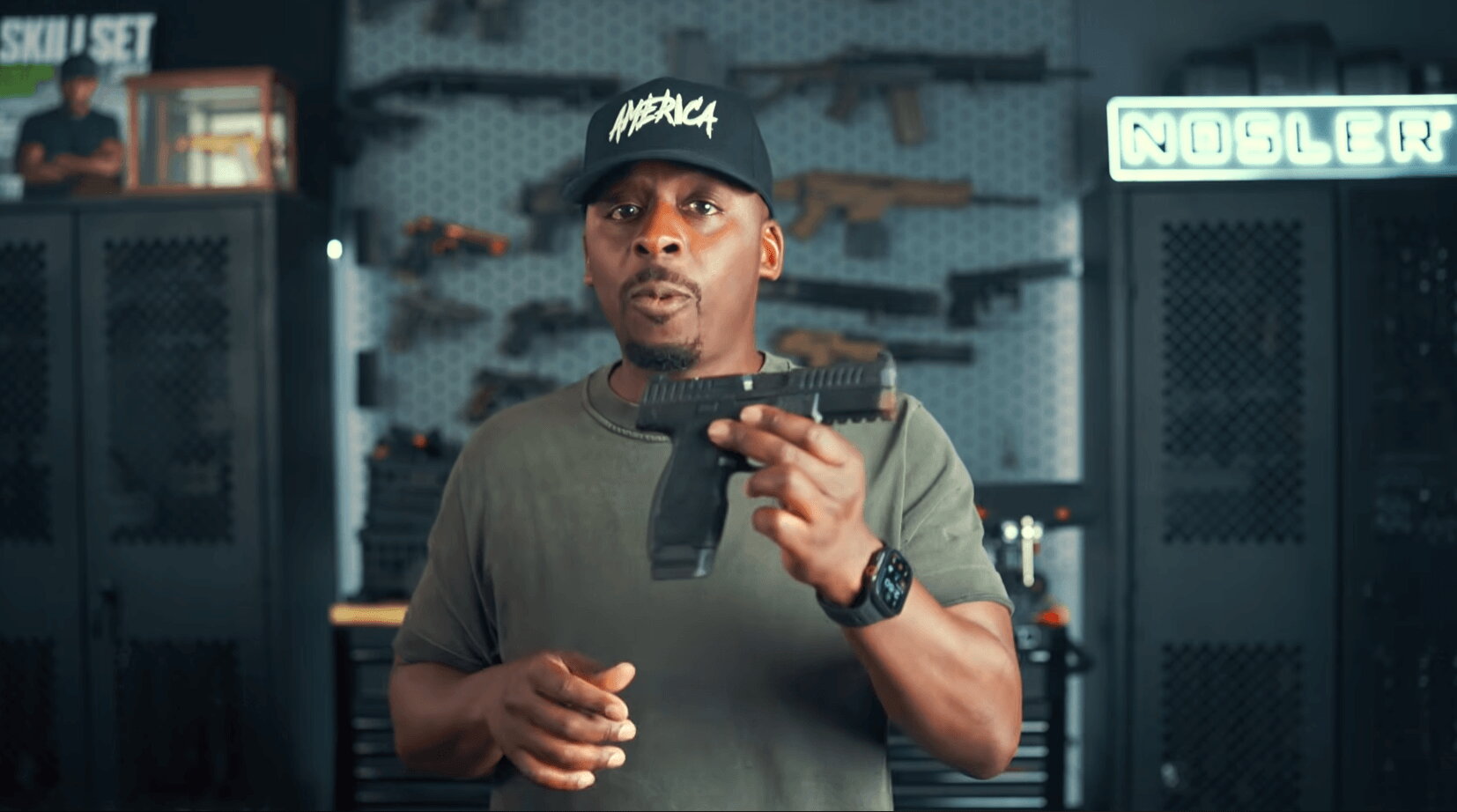
Colion Noir has published a review of the CZ Duty, the polymer-frame, striker-fired 9mm that CZ released in the United States on October 6. The video's title asks whether the Duty is "the polymer gun that finally beats Glock." Noir brings up the comparison in his opening line and comes back to it when he describes how the pistol feels in the hand. His overall verdict is that the Duty is a workhorse, which he defines as a gun that is "good at a lot of things and bad at as few things as humanly possible."
He keeps the Duty separate from CZ's all-metal pistols, saying that comparing a polymer gun to those "just ain't fair." His comparisons stay within polymer striker-fired pistols, mainly the Glock 19 and CZ's own P-07.
CZ Duty specs: four models, one price
CZ is launching four versions: the Duty 4.0 C compact and the Duty 4.0 F full-size, each sold with or without an ambidextrous manual safety. All four have a 102 mm (about 4-inch) cold-hammer-forged barrel and are priced at $729 MSRP. According to CZ's launch specifications, the compact holds 15+1 rounds and the full-size 17+1, and extended base plates add two more to each. The fire-control parts sit in a serialized chassis, and the pistol ships with small, medium and large grip modules.
The slide is cut for Trijicon RMR, Shield RMSc, Holosun K and Leupold DeltaPoint Pro footprints without an adapter plate. Plates are offered for the Aimpoint Acro and Holosun 509T. CZ rates the pistol for 50,000 rounds of service life, or 25,000 rounds of DM51 overpressure ammunition, with no parts changes in the first 10,000. The company says its testing followed NATO STANAG methodology.
Grip, recoil and the CZ Duty trigger
Noir first thought the Duty looked small for a duty gun, then found the grip slim in the hand. He contrasts it with the "bulky brick" feel he associates with the Glock 19. He says the slide has "a little more meat" than other CZ slides, which makes it easier to rack, and that it has deep serrations on the front, rear and top. He reports little muzzle rise and describes recoil as neither stout nor soft, a balance he says suits a pistol meant for heavy training.
His view of the trigger changed between dry fire and live fire. At home, he says, he noticed "a little creep, a little stacking." At the range, he says, the same stacking became a progressive take-up that helped him find the wall again under recoil. He calls it "a very easy trigger to run" and says a duty pistol should not have a very light trigger.
DiFEND ergonomics and the fatigue question
The section Noir calls the part he "couldn't explain" is about hand fatigue. He says that after many magazines his hands were not tiring and the grip felt better the longer he shot. He attributes this to CZ's ergonomic design process. CZ calls that process DiFEND (Digital Firearm Ergonomic Design). The company developed it with the University of West Bohemia starting in 2015, and it uses a biometric digital human model, virtual reality and software tools that CZ says were first developed for NASA. In the video, Noir connects his experience to that process; the video does not include a side-by-side fatigue test.
“His view of the trigger changed between dry fire and live fire: the stacking he disliked on the couch became the take-up he relied on at the range.”
J.D. Whitfield, The ReticleHe also reports that the pistol points naturally. He says that during off-camera point shooting he made hits at distances he "shouldn't have been able to" reach, and credits the grip angle and his own practice.
Duty-use details and one left-handed caveat
Noir lists several features he considers aimed at professional carriers. The magwell has a cutout and the base plate is separated so a stuck magazine can be pulled out by hand. The pistol can be disassembled without pulling the trigger. The slide release and magazine release are ambidextrous. He praises the squared trigger guard, the tritium sights, which sit at a lower one-third co-witness with a dot, and the magazine release, which he calls "satisfyingly positive." He reported one issue, which he attributes to his own technique: when shooting with only his left hand, his thumb rode the slide stop, so the slide did not lock back on the last round. He says this never happened right-handed and advises left-handed shooters to watch their thumb position.
His closing assessment: "Is it the fastest shooting gun I've ever had? No. But it's fast." He says he looked for the pistol's weaknesses and is "kind of still looking."
The video has a sponsored segment for Checkmate magazines, shown on a Springfield Prodigy rather than the Duty, and Noir says Nosler supplied the ammunition used. The video does not say how the review pistol was obtained.
For context
- CZ's P-10 line, introduced in 2017, was the company's first polymer striker-fired pistol family; the Duty is a separate modular design with a serialized fire-control chassis.
- A serialized chassis lets the legally regulated part move between grip frames, the approach popularized by the SIG Sauer P320.
- DiFEND is CZ's in-house ergonomic design method, developed with the University of West Bohemia beginning in 2015.
- DM51 is a military overpressure 9mm load; CZ rates the Duty for 25,000 rounds of it.