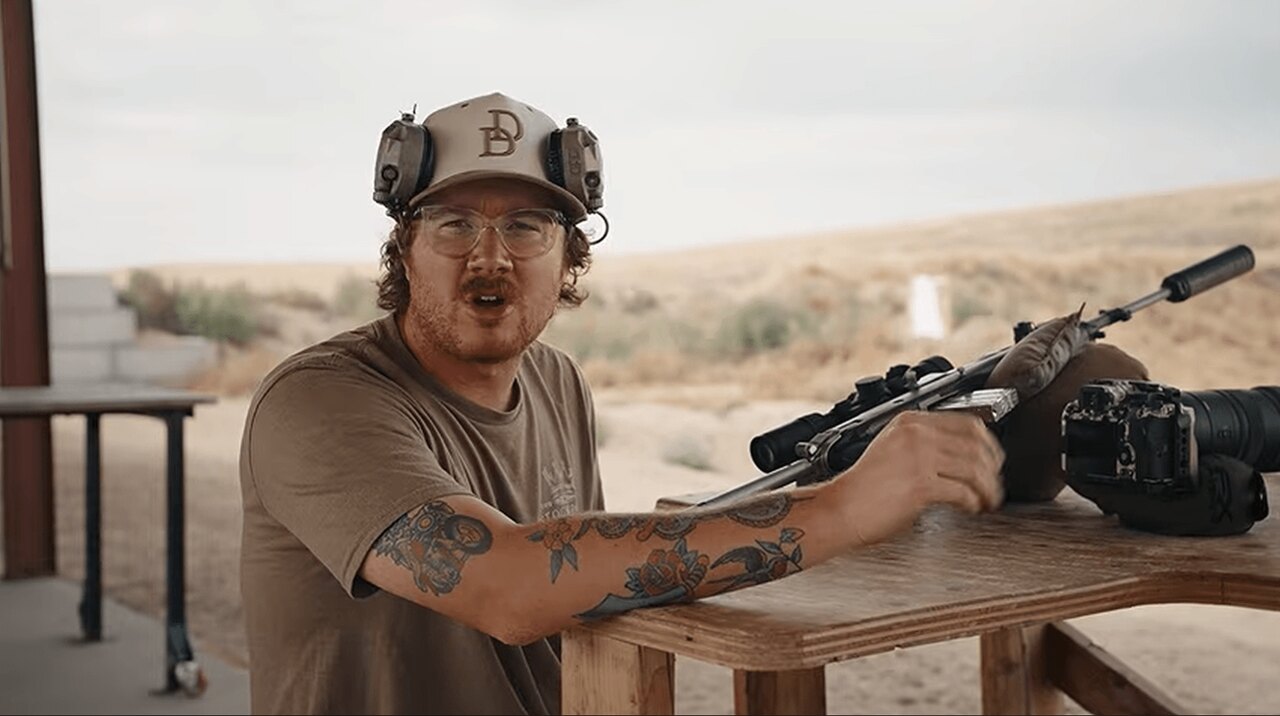
Why it matters: A channel with 4.6 million subscribers has put a 24-minute fallout procedure in front of a firearms audience, which makes its handling of shelter times, decontamination and EMP effects worth checking against the federal documents most viewers will never open.
Garand Thumb published "How To Survive a Nuclear Strike - First 72 Hours" on September 6, a 24-minute scripted scenario in which host Mike Jones and two others act out the aftermath of a nuclear attack from a forested position the video places roughly 40 miles from two struck military bases. The sequence starts with a high-altitude electromagnetic pulse, moves to tactical detonations on the bases, and then works through casualty checks, contamination control, a vehicle repair, and a shelter-in-place stay in a cabin basement.
What the Garand Thumb nuclear scenario stages
The opening narration describes the EMP as a bright flash with a range of hundreds to more than a thousand miles, knocking out larger systems while cell phones survive and vehicles come out "hit or miss." For the detonations themselves, the video tells viewers to lie down facing away from the blast to limit injury from kicked-up debris, and to time the interval between flash and pressure wave, noting that the wave takes more than three minutes to arrive at the stated distance and cautioning that nuclear blast propagation does not track sound-wave math exactly.
The first on-camera action is not radiological. Jones, described in the video as former Air Force Special Warfare, and Preston, identified as a National Guard member, run a check-in and a blood sweep, on the stated reasoning that uncontrolled bleeding will kill someone before radiation does. The video calls the first seven hours the most dangerous window for early gamma exposure, on the grounds that surface detonations loft irradiated debris that wind can carry in directions a group cannot predict from where it stands.
Contamination control, Geiger counters and flash blindness
The video's improvised anti-contamination suit is presented with an explicit limit: Jones says gamma radiation passes through it, and that the suit's only job is keeping particulate off skin and out of open wounds, eyes, nose and mouth. Removal gets the same treatment — mask kept on, clothing peeled off slowly rather than shaken, the discarded layer bagged and buried away from the group, a wash without scrubbing, and equipment wiped with a cloth that goes into the same bag.
A Geiger counter runs through the whole scenario, on the ridge and later out a car window on the drive to the cabin. The video describes normal background as "between 5 to 50" without naming units in that segment, and frames the instrument as a go or no-go tool: if readings spike, turn back rather than turn two casualties into three. The scenario also stages a secondary effect rather than describing one. Two characters watching the fireballs from a ridge are temporarily blinded, fall from a cliff and are found dead, and the video cites car crashes, pile-ups and falls from ladders and roofs as documented consequences of flash blindness and blast waves.
EMP effects on vehicles and the spare parts kit
On electronics, the video separates infrastructure from pocket items. Internet service, satellite links, GPS and radio repeaters are treated as down; cell phones and Geiger counters are described as likely to survive a high-altitude pulse, with a recommendation to store batteries outside devices that are not in use. Vehicles get a longer segment and a hedge, with the video saying the question is harder and promising a fuller treatment later.
“The video's most repeated instruction is also its plainest: get behind mass, stay there, and let the decay curve do the work.”
Marcus Hale, The ReticleThat segment is built around Aaron, introduced as the owner of Foreign Connect Imports, a business that imports older and mechanically simpler vehicles, and the video recommends importing such a vehicle from him. His kit is four vehicle-specific spares — the ECU, the alternator, the engine speed sensor and the injection pump timing control valve — sourced used, kept with the vehicle, and described as installable with a small tool belt and some prior study. The 2008 EMP Commission report to Congress found that roughly 15 percent of running vehicles were affected by fields at or above 25 kV/m, most of them restartable, with the larger hazard being the accidents caused by cars slowing suddenly rather than permanent failure.
Shelter, water and food in the first 72 hours
The back half turns on one repeated instruction: get behind mass. The group drives to a cabin, moves into the basement, and plans on 48 to 72 hours there, with the stated principle that more earth and concrete between a person and fallout is better, and with periodic Geiger checks near windows and exits rather than an assumption that underground means clear. Sleeping and waste areas get designated. On water, sealed stored containers come first; open creeks are rejected because they collect deposition from open air and runoff across contaminated ground, while a protected deep well with a pump or a spring piped directly from underground is presented as usable. Food follows the same rule — sealed and stored is fine, cans exposed outside get wiped with wet disposable towels that are then discarded, and unsealed food that sat in open air is thrown out.
The video states the 7:10 rule, that a sevenfold increase in time brings a tenfold decrease in radiation level, and then illustrates it with an example that steps down in consecutive seven-hour blocks. The rule as written in Department of Homeland Security responder training multiplies elapsed time by seven at each step: one hour to seven, seven to 49. Jones attaches his own caveat to the arithmetic, telling viewers that a place can remain hot after several tenfold decreases and that the counter, not the clock, decides when to move.
Federal public guidance compresses the same period into three instructions — get inside, stay inside, stay tuned — and asks for a minimum of 12 to 24 hours inside before people follow direction from authorities, with FEMA planning material estimating potential exposure falls roughly 80 percent by the end of the first day. The video's 48 to 72 hours is longer, and its scenario supplies the reason: a group in a wood-frame cabin outside a target area, without official communication until a CB radio reaches government emergency channels on day four. The scenario closes on a tertiary effect rather than a clean exit, with thermal ignition starting a forest fire that forces the group to move anyway.
For context
- Garand Thumb is hosted by Mike Jones, a former U.S. Air Force Special Warfare TACP, and the channel lists 4.6 million subscribers across firearms, military and survival content.
- The channel has run survival material before, including the five-gun survival battery The Reticle covered on August 9.
- Federal public guidance for a nuclear detonation is "get inside, stay inside, stay tuned," with FEMA asking for at least 12 to 24 hours inside before following instructions from authorities.
- The 2008 EMP Commission report to Congress found roughly 15 percent of running vehicles affected by fields at or above 25 kV/m, with accidents rather than permanent failure the main hazard.