Why it matters: The 2025 law that zeroed the NFA tax on suppressors and short-barreled rifles was a budget provision, and a budget provision can be rewritten by a simple Senate majority. The midterms handed the pen to the party that opposed the cut. The 2028 election decides whether anyone signs.
Two days after the midterms, William Kirk of Washington Gun Law told viewers the election "may have ended the NFA honeymoon." His argument fits in one sentence from his November 5 video: "that which could be done through budget reconciliation could also be undone through budget reconciliation." The 2025 reconciliation law cut the National Firearms Act's making and transfer taxes on suppressors, short-barreled rifles and shotguns, and "any other weapons" to $0 on January 1. On November 3, Democrats won both chambers: by Saturday's Associated Press count, 254 House seats to 162 with 19 races uncalled, and 54 Senate seats, counting two independents, with two races still open. The party that opposed that cut will write the next budget.
The majority's left wing grew too. By the Democratic Socialists of America's own count, eight of its members will sit in the next House, up from two, and a DSA member already runs New York, with DSA mayors taking office in Los Angeles in December and Washington in January. Antiso, a website tracking socialism in America, argues in a post-election piece that the movement has been candid about guns.
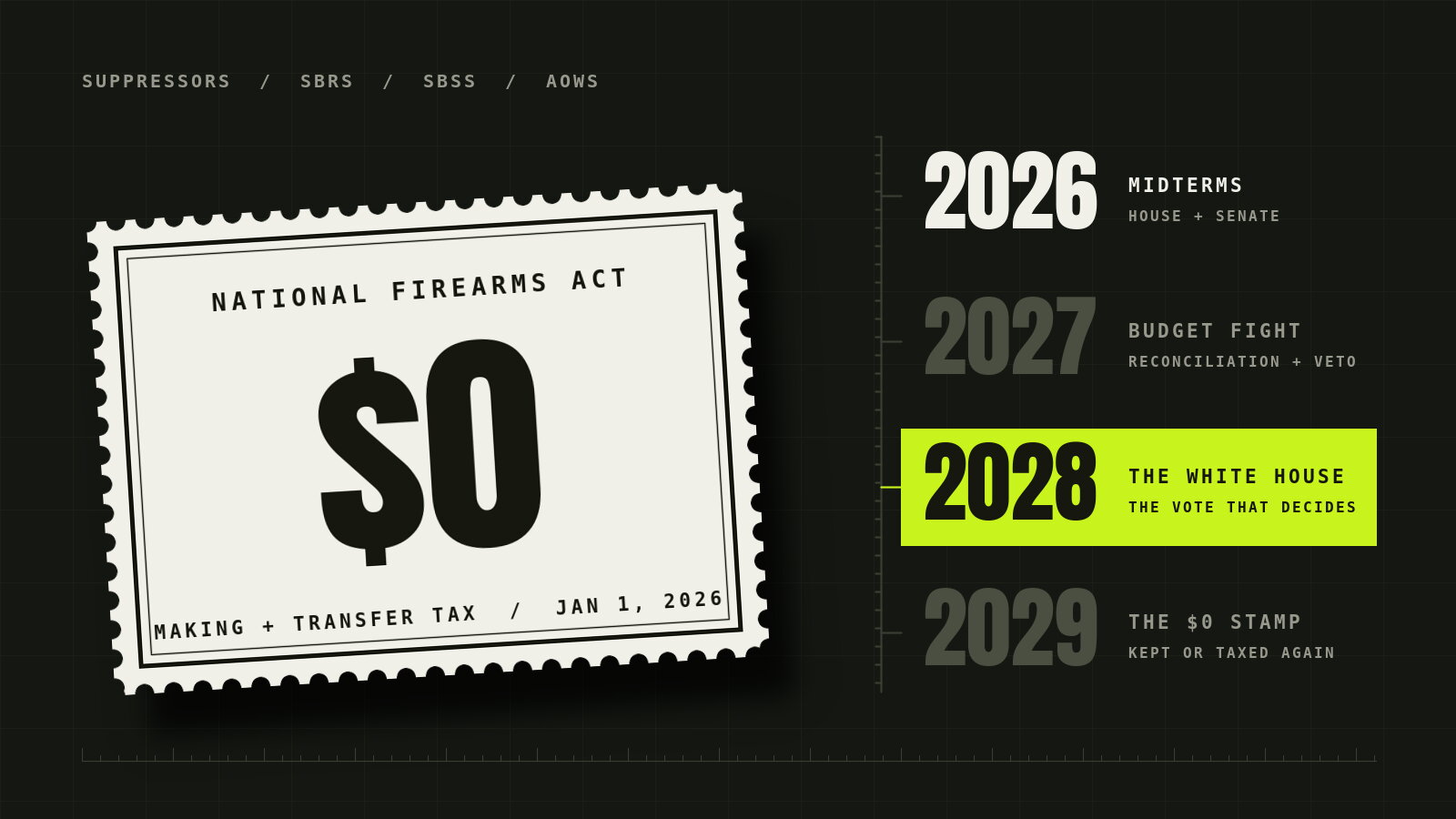
Our view: the midterms did not put gun control within reach. They set the earliest date it could arrive. A Democratic Congress can draft the NFA tax's return and dare President Trump to veto it, but only a Democratic president would sign it. That makes 2028, not 2026, the election that decides whether the $0 stamp survives.
Budget reconciliation could bring back the NFA tax
The tax is the hinge. In Silencer Shop Foundation v. ATF, a federal court in Texas held on August 5 that with the tax at $0, the NFA's making, registration and transfer rules for those items are no longer a valid use of Congress's taxing power. The Justice Department declined to appeal, ATF stopped enforcing those rules nationwide on October 9, and the judge put the burden on Congress: "Efforts to render the NFA constitutional must come from Congress, not this Court." ATF's own guidance lists what could bring enforcement back: "Congress could impose a new tax on NFA firearms," or "the Department could rescind the enforcement guidelines." Kirk's version: change the tax "from 0 to even $1" and the premise "crumbles."
Reconciliation is the cheap way to move that number, because it needs only a simple majority and cannot be filibustered. In 2025, the Senate parliamentarian struck the provisions that would have pulled suppressors and short-barreled rifles out of the NFA but let the $0 rate through. A tax rate is budget business; registration is not, and a rate going back up would very likely count as budget business too. The calendar is public: Congress is supposed to adopt a budget resolution by April 15, a deadline it usually misses, and to finish reconciliation by June 15. Kirk says Sen. Chris Murphy wants ten times the old tax. Murphy's amendments, filed in July 2025 and January 2026, would charge $4,709 per transfer, the 1934 tax adjusted for inflation and more than 23 times the old $200. Neither got a vote.
Presidential veto holds the line on the NFA tax until 2029
A budget bill gave gun owners the $0 stamp, and a budget bill can take it back, but it still needs a signature. Under the Constitution's presentment clause a president signs a bill whole or vetoes it whole, and the Supreme Court struck down the line-item veto in Clinton v. City of New York in 1998. Kirk worries about a $1 line tucked into a package the president wants. The likelier 2027 runs the other way. Presidents have vetoed four reconciliation bills, most recently in 2016, and Congress has never overridden one. President Trump answered the election with a photo of a red hat that read "VETO."
Kirk expects the new majority to make a ritual of it, passing bills with names like the "Protect Our Communities Act" so the next campaign can say, "We offered this act... He vetoed all of them." Days before the vote, Rep. Greg Casar, chair of the Congressional Progressive Caucus, answered Sen. Brian Schatz, who had warned against bills the president is guaranteed to veto. If Trump vetoes Democrats' "popular, pro-affordability policies," Casar wrote, "We'll run on them in 2028 and pass them in 2029." He was not talking about guns, but the schedule applies to them too. As Kirk notes, a turn at the ATF "would require also a change in the executive office," which cannot come before January 2029.
DSA and guns: the record behind the 2028 stakes
Antiso's report on socialists and the Second Amendment calls two essays on DSA's national website "positions published by the organization." They are signed posts: a 2013 essay by Steve Max, then billed as a DSA vice-chair, headlined "There Is No Second Amendment Right To A Gun," and a 2018 piece, "The Second Amendment Is a Threat to Us All," that proposed repealing the amendment and banning semi-automatic and pump-action firearms. Both carry DSA's standard note that signed posts do not necessarily reflect the organization's views. The organization's own voice is its 2026 program, approved by its National Political Committee and published in July. It has no plank on guns, but it calls for steps "towards fully abolishing the police and prison system" and would "replace the President and Supreme Court with an executive and judiciary chosen by and subordinate to Congress." The Second Amendment has survived the last two decades because an independent Supreme Court could tell legislatures no.
“A budget bill gave gun owners the $0 stamp, and a budget bill can take it back, but it still needs a signature.”
The Editorial Board, The ReticleEight votes will not decide much in a House where Democrats have won more than 250 seats. The bloc's leverage runs through primaries and through 2028. DSA-backed challengers ousted four sitting House Democrats this year: Diana DeGette, Shri Thanedar and Adriano Espaillat in primaries and Jimmy Gomez in November. DSA's election statement names its next goal: its members are "a core constituency to a potential socialist victory in 2028." Antiso's look at DSA's new House bloc frames the question: "what they would demand as the price of their votes, and how much a Democratic administration could hand them without winning a single Republican vote."
If a Democrat wins in 2028, the first move would be the ATF, not a bill, says Antiso's analysis of socialism and gun rights. The braced-pistol rule and the 2024 "engaged in the business" rule were written by the bureau, not Congress. Courts vacated the first and have limited the second, and the administration has proposed rescinding the first and much of the second, but neither is final, and a new ATF can write its own. A new Justice Department could also rescind the guidance that paused NFA enforcement for suppressors and short-barreled rifles. A Democratic trifecta could restore the NFA tax the way it was cut, through reconciliation, with 50 senators and a vice president.
No major Democrat has declared for 2028, but the shortlist's records are public. Gavin Newsom has proposed a constitutional amendment that would bar civilian purchases of assault weapons. JB Pritzker signed Illinois's ban on them. Alexandria Ocasio-Cortez, who has not ruled out a run, voted for the House's 2022 ban. Andy Beshear opposed such a ban in 2019. Two DSA newcomers, Chris Rabb and Donavan McKinney, voted for their states' 2023 background-check bills.
Suppressor and SBR owners: what to do before the 2028 election
Kirk leans toward buying soon: for anyone thinking about NFA items, "the next few months might be exactly the time to do that." He also expects "a grace period, an amnesty period" if the tax returns, and argues that entrapment by estoppel would protect owners who relied on federal guidance. Courts read that defense narrowly, and ATF is less reassuring. Its guidance says federal law does not generally permit registering NFA items after the fact and has no provision to "automatically grandfather" unregistered ones, though the attorney general may declare an amnesty of up to 90 days. ATF still accepts voluntary registrations and notes that most states require NFA items to comply with federal law, so buyers should register anyway and check state law. Owners who skip the paperwork because no one is enforcing it are betting on an amnesty nobody has promised.
Watch the next budget resolution for revenue instructions to Ways and Means and Finance, the committees that write the NFA's tax rates. Watch the Supreme Court, which hears the AR-15 cases on December 2 and should rule by the end of June. And treat 2028 as the election that decides whether the 2025 gains are kept or taxed away. The midterms did not take anything from gun owners. They started a clock.
For context
- The 2025 reconciliation law set the NFA's making and transfer taxes to $0 for suppressors, short-barreled rifles and shotguns, and any other weapons, effective January 1, 2026; machine guns and destructive devices still carry the $200 tax, and the registration statute was not repealed.
- In Silencer Shop Foundation v. ATF, a federal district court in Texas held on August 5, 2026 that NFA registration rules for $0-tax items no longer rest on Congress's taxing power, the basis on which the Supreme Court upheld the NFA in 1937; the injunction covers the plaintiffs and their members and customers, and since October 9 ATF has declined to enforce those rules against anyone, a policy its guidance says the Department could rescind.
- Reconciliation bills cannot be filibustered, but they go to the president, who must sign or veto each one whole; Congress has never overridden a reconciliation veto.
- The Supreme Court hears Viramontes v. Cook County and Grant v. Higgins, the Cook County, Illinois, and Connecticut AR-15 cases, on December 2, 2026; after petitioner Cutberto Viramontes moved to withdraw, Cook County suggested the Court dismiss its case if he leaves, noting that the consolidated Connecticut case would still let the Court decide the question.
Themes in the source
Room for disagreement
The strongest case against our timeline comes from gun-rights pragmatists who watch votes rather than essays. The DSA bloc is eight members in a House where Democrats will hold more than 250 seats, and DSA's own post-election priorities were Medicare for All, an arms embargo on Israel and abolishing ICE, not guns. Its 2026 program has no gun plank, the essays that alarm gun owners are signed blog posts, and a 2022 essay in DSA's own journal conceded that the group has members on both sides of the issue and tends to avoid it. The DSA members who govern have acted like mainstream Democrats, not like the essays: New York's mayor answered shootings with violence-intervention money. The last Democratic trifecta passed two reconciliation bills and put no gun tax in either. Democratic leaders ran on prices and health care, and the new Senate majority rests on Democrats just elected in Texas, Kansas, Iowa and South Carolina, who would pay dearly for a gun tax. Even a restored tax would not automatically revive registration: ATF says only that enforcement "could" resume, and the courts would have the last word. On this view, the decisive arenas are the Supreme Court's AR-15 cases and the NFA litigation, and the best use of the next two years is winning there and keeping red-state Democrats cautious, not treating every socialist essay as a forecast.
The bottom line
The midterms did not doom the $0 NFA tax; they put it on a clock. The new Congress can draft its return and dare a veto, but only a Democratic president would sign it, in 2029 at the earliest, which makes 2028 the election that decides whether the 2025 gains last.