Why it matters: The Hall rifle was the first breech-loader the U.S. Army adopted, and original examples are seldom fired on camera. This video sets the rifle's recorded trial claims beside what two modern shooters got from one in an afternoon.
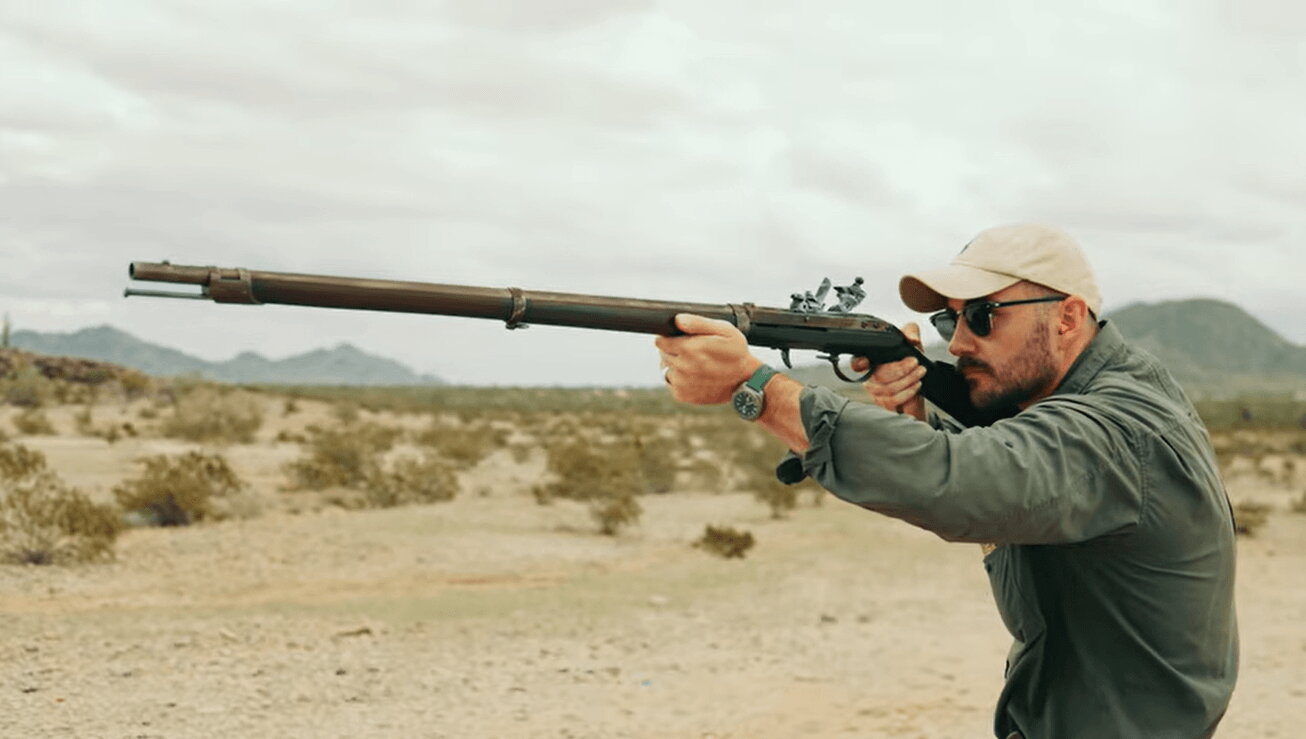
The YouTube channel Administrative Results posted a video on November 11 titled “Shooting The US Army's First Advanced Rifle,” built around an original Model 1819 Hall rifle. The rifle belongs to the guest, Revere0311, who says this example was made in 1838. The two fired it in the Arizona desert, alongside the host's own Ferguson rifle, a British breech-loading flintlock.
The guest supplies most of the history, and the host supplies most of the shooting impressions. Revere0311 credits much of that history to the books of Hall historian Peter A. Schmidt and says they are no expert on the rifle.
How the M1819 Hall rifle loads and fires
The video walks through the loading sequence. The shooter primes the pan first, sets the lock at half-cock, and pulls a lever that tilts the rear of the breech block up. Powder and ball go into the front of the raised block, which is then pressed back down. The pair used a 75-grain charge of 2F powder. The guest notes that priming before loading was the military manual of arms of the period, while many ranges today require loading first and priming last.
The rifle does not seal fully at the joint between block and barrel. The guest says each shot sends powder out through the stock and down into the mechanism, and argues the rifle loses energy as a result. Later in the video the guest shows the inside of the action already caked with fouling after a short session. Because the lock sits on top of the block, the front sight is offset from the barrel's centerline. The guest relays John H. Hall's claim that putting the flash directly in front of the shooter's face would reduce flinching. Both shooters said they still flinched.
The host rated recoil with the 75-grain load as manageable. A switch to 3F powder at the host's request produced what the host described as noticeably more blast back toward the face.
Hall rifle rate of fire vs the 1826 trial claims
The guest cites the 1826 trials at Fort Monroe as the source of the often-repeated figure of seven to nine shots a minute. The guest says the math from one report works out to about 3.5 a minute, and that their own pace with paper cartridges is three to four. In a timed minute using a flask of loose powder, the host managed four shots and named the flask's slow pour as the bottleneck.
The host called overfilling the chamber the rifle's biggest weakness. If too much powder goes in, the ball will not seat and the block will not close, and the excess has to be cleared by hand. On the Ferguson, the host says, surplus powder is pushed out when the breech closes and simply wiped away. In the prone position, both shooters had to raise the rifle to load. The host added that the Hall needs no grease on its action, unlike the threaded Ferguson breech plug, and cannot drop its breech.
Hall rifle service history and replacement by the Model 1841
“The 1826 trials are remembered for seven to nine shots a minute; with a flask of loose powder and a timer running, the host managed four.”
J.D. Whitfield, The ReticleThe guest gives a timeline: an 1811 patent, Army trials of about 100 rifles in 1816, and an 1819 contract for 1,000 rifles at Harpers Ferry, with the first guns finished in 1824. The guest puts total output of the Model 1819 rifle at about 20,000, with more made as carbines and percussion variants. According to the guest, the rifle went mainly to light and flank companies, often split about evenly with the Model 1803 Harpers Ferry rifle. The guest places its combat debut in the 1832 Black Hawk War with the 6th U.S. Infantry, and cites a first-hand account that it performed poorly in Florida during the Seminole Wars.
According to the guest, government testers once ran 8,000 rounds through a single rifle, at times 500 rounds a day, and a congressional report projected about 800,000 rifles over 20 years. The guest says the unit cost fell to about $13 by the end of production, against roughly $9 to $11 for a smoothbore musket from the national armories. The host cites an 1837 report in which Hall rounds fired at 300 yards failed to mark seasoned white oak that a muzzle-loading Model 1803 could. The Army instead adopted the Model 1841 muzzle-loading percussion rifle. The guest says they have never found a primary document explaining why, and asked viewers who know of one to share it.
The episode also has the pair removing the breech block and firing it in the hand. They were testing a reported Mexican-American War account of a soldier using the block as a pistol, and the host said afterward they had doubts about the story.
Hall rifle vs Ferguson rifle: the host's verdict
Asked which rifle to carry into combat, the host chose the Ferguson, allowing that more practice with it may be the reason, and floated the muzzle-loading British Baker rifle as the safer pick. The host said the Hall would suit close country and firing on the move, where its rate of fire counts most. The video is sponsored by OpticsPlanet, Sonoran Desert Institute and Badlands Munitions.
For context
- John H. Hall patented his breech-loading design in 1811 and built the rifles at Harpers Ferry Armory, where the National Firearms Museum puts production at nearly 20,000 rifles through 1840.
- In 1826 a military commission tested Hall's claim of interchangeable parts by disassembling 100 rifles, mixing the parts, and reassembling them without reported problems.
- The Ferguson rifle is a British breech-loading flintlock with a screw-plug breech, fielded in small numbers during the American Revolution.
- Peter A. Schmidt's 1996 book “Hall's Military Breechloaders” is the standard reference on the rifle and its manufacture.