Why it matters: A prototype that never reached a trial is still a record of what the Pentagon asked American manufacturers to build in the 1980s, and of how one of them answered. The video puts all three surviving guns on the same table for the first time on camera.
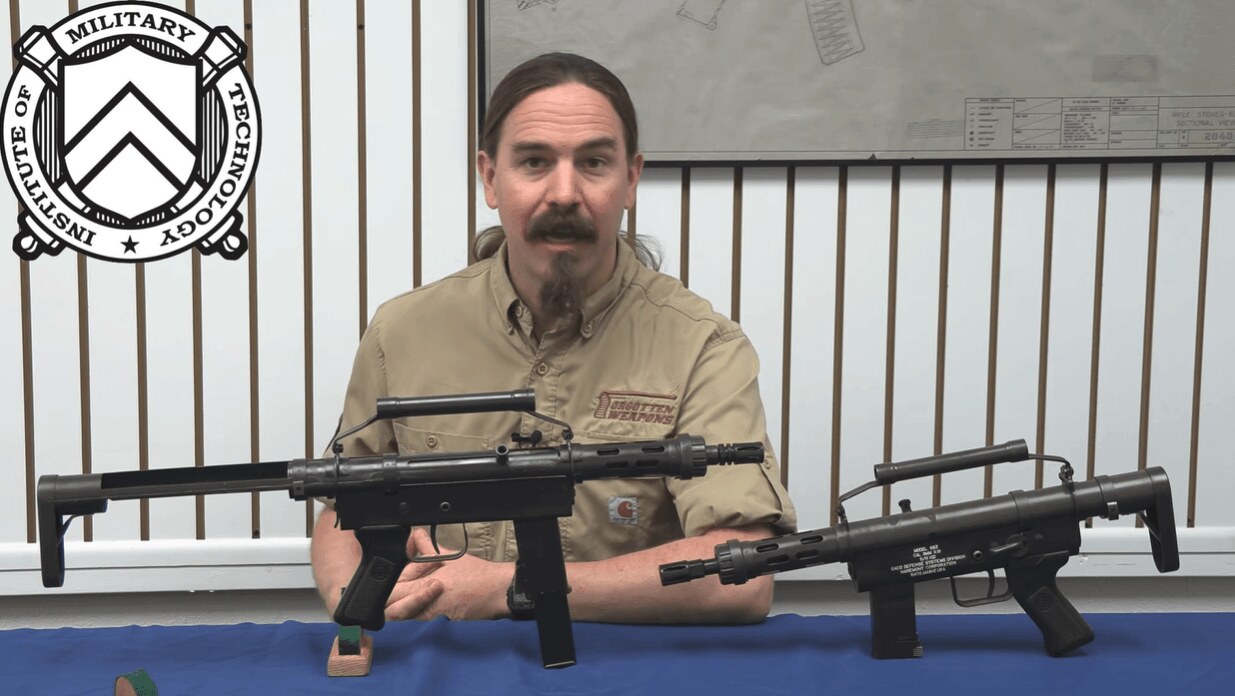
A Forgotten Weapons episode published September 2 puts all three known SACO Defense Model 683 prototypes side by side and strips one of them down next to the Brazilian submachine gun host Ian McCollum says it was copied from. The guns — serial numbers 101, 102 and 103 — belong to the Institute of Military Technology, which gave McCollum access to film them.
The markings on serial 101 read Model 683, 1983, 9mm Parabellum, and Saco Defense Systems Division. The mechanism is about as plain as submachine guns get: simple blowback, firing from an open bolt, with a three-position selector for safe, semi-automatic and automatic fire. The whole gun is two tubes — a receiver and a stock — plus a threaded barrel nut, a drop-out fire control group and a bolt with a slot cut for the recoil spring.
A 1983 answer to a Pentagon small arms requirement
McCollum places the gun inside the Joint Service Small Arms Program, the standardization effort set up in the late 1970s to reduce the number of different small arms in US service. The pistol side of that work led to the XM9 trials and, eventually, the Beretta M9. The submachine gun side produced a requirements document and no adopted weapon.
In the video, McCollum characterizes those requirements as internally contradictory: a relatively low cyclic rate alongside a much faster burst option, and easy conversion between 9mm and .45 ACP. Heckler & Koch's early-1980s submachine gun work was also a response to the same request for proposals. SACO Defense, the Maine company then best known for building M60 machine guns, was one of the firms that answered.
How close the M683 sits to Brazil's Uru
The Uru was designed by Olympio Vieira de Mello and put into production in 1977 by Mekanika Indústria e Comércio in Rio de Janeiro, where it was bought by Brazilian military and police units. Its selling point was parts count: the design is commonly described as running to 17 main components.
McCollum says SACO obtained one and copied it, and the teardown is the argument. He removes the barrel nut, presses a spring-loaded button to drop the lower assembly, pulls the charging handle and slides the bolt out the front — then repeats the identical sequence on the Uru. "If I didn't tell you," he says of the two field-stripped guns, "you might be hard-pressed to determine which of these was which." He notes the parts are not quite interchangeable: the barrel thread pitches differ, which he suspects is metric against imperial, and the feed ramp profiles are cut differently, though the bolts will swap between the two receiver tubes.
What SACO added is on the outside. A telescoping stock tube slides over the receiver and is slotted so the ejection port and charging handle stay clear, letting the gun be fired collapsed. A carry handle doubles as a tunnel sight — not an optic, but a hollow tube with a single crosshair at the front, aligned by centering the crosshair in the tube and zeroed by loosening a screw and shifting the assembly. There is a flash hider, which McCollum notes matters little on 9mm. And where the Uru fed from MP40-pattern magazines, the M683 uses Uzi magazines.
What changed between gun 101 and guns 102 and 103
“Three guns, one borrowed design, and a program that adopted no submachine gun at all.”
J.D. Whitfield, The ReticleSerial 101 required a modification: an extra notch cut in the back of each Uzi magazine to work with a rear magazine catch. On 102 and 103 the catch moved to the side and engages the slot Uzi magazines already have, so the guns run standard magazines. The later pair also carries an in-house flash hider in place of the M16 unit on gun one, a larger cast selector lever, and a rounded rather than squared lower assembly.
The substantive change is inside. The Uru uses a single component that serves as both trigger and sear, with a cam slot that lets it disconnect itself in semi-automatic. Guns 102 and 103 replace it with a conventional multi-piece group in which a disconnector bar catches the bolt and holds it until the trigger is released. McCollum offers an inference rather than a document for why: he says SACO showed the gun to the Uru's designer, that the Brazilian manufacturer threatened legal action, and that he has found no reference to a suit actually being filed.
Why the M683 stopped at three guns
No submachine gun was adopted out of the program, and by McCollum's count only three M683s were built — all three now at the IMT. He points out the capability the design never got to use: because the barrel unscrews at the front, a .45 ACP barrel assembly or an integrally suppressed unit could have dropped straight in, the way the M3 grease gun handled it. Neither was built.
SACO Defense stayed in the small arms business well after the M683 ended at three prototypes. The company's Saco, Maine plant continued machine gun production, and SACO served as the US entrant for the SIG Sauer P226 in the XM9 trials that closed out the pistol side of the same program. The site is now part of General Dynamics.
For context
- The Joint Service Small Arms Program was established in December 1978 to standardize small arms across the US military branches.
- The Mekanika Uru was produced in Brazil from 1977, with total output for military and police customers commonly estimated at around 10,000 guns.
- The Institute of Military Technology is a private collection that regularly provides prototypes and reference weapons to researchers and media.
- SACO Defense built M60 machine guns in Saco, Maine; the plant was later acquired by General Dynamics.