Why it matters: Two of the products in this range-day tour are aimed at gaps in the market: an affordable 1911 built to match the Marine Corps M45A1, and suppressor designs meant to reduce noise and concussion without a conventional baffle stack. The video shows both companies' claims before any independent testing has been published.
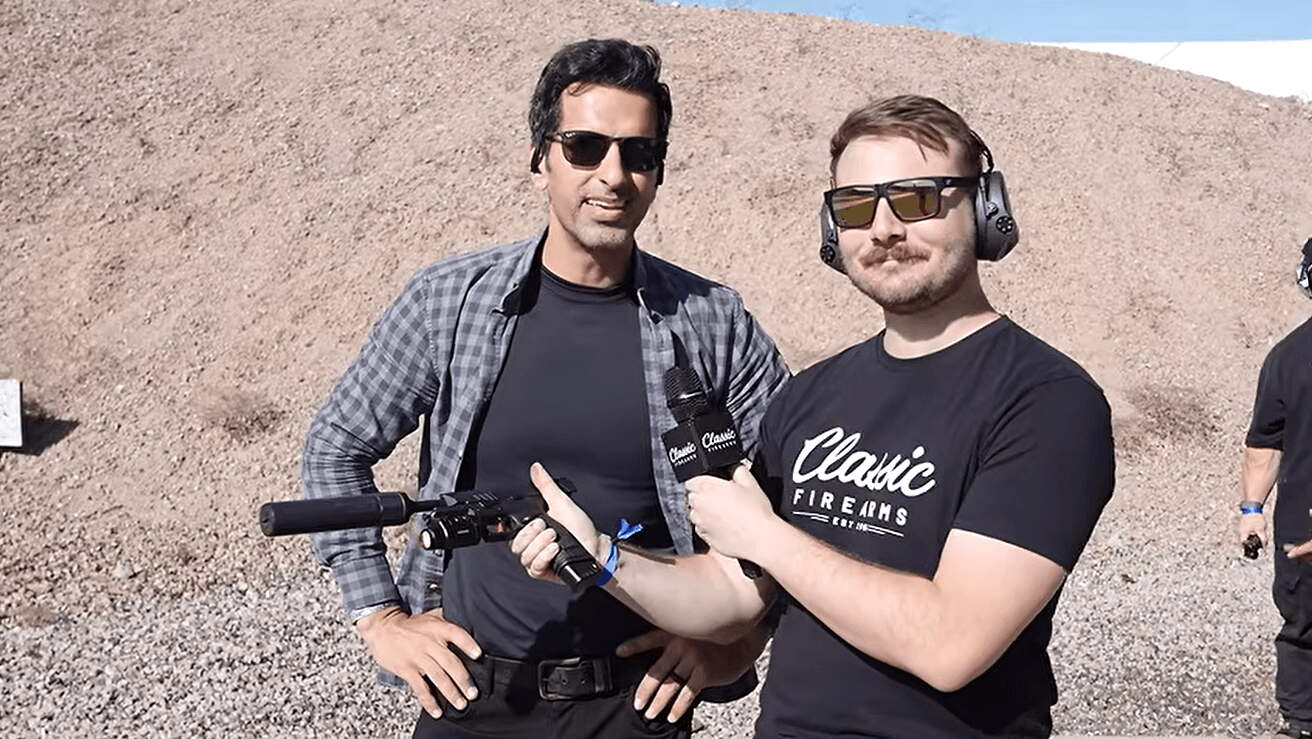
Classic Firearms' latest event video, posted to YouTube on November 16, follows the retailer's host through the Brandon Herrera and Donut Operator range day at Pro Gun Vegas. The 27-minute tour opens on Herrera's .50 BMG AK-50, but most of its runtime goes to two exhibitors: Tisas, which used the day to show a reworked M45A1 Raider 1911, and Advantage Arms, which brought three suppressor and muzzle-device prototypes.
Tisas M45A1 Raider: a 1911 rebuilt to match the Marine Corps pistol
At the Tisas booth, a company representative identified on camera as Kai walks through what he calls the new Tisas M45A1 Raider. He says the earlier Raider functioned well but was not a true copy of the M45A1, the Colt-made 1911 the Marine Corps adopted, and that Tisas went back and identified the parts that did not match.
The list he gives is long. According to Kai, the slide serrations now match the original in count and depth, the hammer and external safety are changed to match, and the grip safety beavertail is milled rather than made by metal injection molding (MIM). He says the original pistol's beavertail is a MIM part, which is why the Tisas version differs very slightly in shape. He adds that MIM done well can be just as strong, and that Tisas avoided it on moving parts because of its reputation, calling the choice a personal one.
Other changes he lists: G10 grip panels reworked to match the original's color layering, larger grip screws, a heavier Picatinny rail, a bushing color-matched to the original's gray, and a Cerakote shade he describes as a one-to-one match for the original M45A1 finish. The slide carries a working QR code that links to the Raider page on the Tisas website, alongside markings he says are the company's own take on the original's identification numbers. One example is 01993, a reference to the year Tisas was founded.
Some features are deliberately left out. The M45A1 Raider has no optics cut and no threaded barrel, because the original had neither. Its sights are three-white-dot units rather than the original's tritium night sights, which Kai says keeps the price down; the dovetails accept Novak-pattern sights for owners who want to upgrade. He says the pistol uses forged slides and frames, cold-hammer-forged barrels and no MIM parts in its internals, that tolerances are tighter than on the previous Raider, and that the guns have run without stoppages so far. He puts the price in the $600s.
Kai also refers to an upgraded double-stack 1911, a Remington Rand-style World War II 1911, and the PX9 Gen 3, which he says brings improved slide serrations, controls and trigger. He declines to describe a new 9mm pistol he says is coming.
Advantage Arms 86 Blackout integrally suppressed prototype
At the Advantage Arms booth, a company representative named on camera as Brandon shows the 86 Blackout, an oversized prototype that replaces an AR-15's handguard with a suppressor shroud. He says the prototype was test-fired the day before the event and has walls about three times thicker than a production version would need. The company built it heavy on purpose to find out how quiet the design can get, and plans to slim it down later, possibly with carbon fiber, while holding that number.
“The new Raider drops the optics cut and threaded barrel of the earlier model, because the Marine Corps pistol it copies had neither.”
J.D. Whitfield, The ReticleThe unit threads onto the barrel's 1/2x28 muzzle thread and rests against the barrel nut instead of attaching to the receiver, which Brandon says was the simplest approach for a prototype. He describes the design as a spin-off of an integrally suppressed system that taps barrel gas before it reaches the muzzle. With subsonic 300 Blackout, he says the company measured readings of about 121 to 123 decibels. Work started at the beginning of summer, and he estimates three to four more months of development, adding that this may be optimistic for a market date. He says the minimum product would be a complete upper with barrel and suppressor.
Tesla-valve suppressor and flash hider for hunters and home defense
Brandon also shows a suppressor his company calls the ribbed unit for now. He says it is based on a Tesla valve, a fixed-geometry channel that resists flow in one direction, built as a three-dimensional stack that routes gas back around the bullet instead of through conventional baffles. He gives the length as 2.5 inches and says it takes a 5.56mm report of about 165 decibels down to about 145, and to as low as 141 on a longer-barreled bolt gun.
He says the goal is not hearing-safe levels but less damage in situations where shooters go unprotected, citing hunters in North Idaho who skip ear protection, and home defense. After firing it, the Classic Firearms host says the concussion was much lower than he expected. The video's title calls it the world's smallest 5.56 suppressor; on camera the host says only that it might be.
The last prototype is a mesh flash hider that Brandon says performs as well as or better than a birdcage on flash, citing the company's own test paperwork, and is the quietest flash hider on the market. He pitches it at buyers in California, where civilians cannot own suppressors. He declines to give decibel figures but says a report that would carry 2,000 meters is cut to 850 meters with the device.
Laugo Arms, GOA and footage lost to audio problems
The video notes that audio failures cost the crew its interviews at Go Guns, Gun Owners of America and Laugo Arms, which are covered with B-roll and narration instead. The host says he shot Laugo's Alien, Alien Creator and Remus pistols, preferred the Creator's 1911-style grip angle, and that a Laugo representative agreed when asked whether the line has the lowest bore axis in the world. The host invites viewers to say in the comments whether that holds.
For context
- The M45A1 is a Colt-built .45 ACP 1911 adopted by the Marine Corps as its close quarters battle pistol in 2012.
- The earlier Tisas Raider, sold as the 1911 Duty B45RDG, is a threaded, optics-cut pistol that reviewers have described as close to the M45A1 but not an exact copy.
- Metal injection molding forms small steel parts from a powder-and-binder feedstock, and is cheaper than machining at volume.
- Suppressors are regulated under the National Firearms Act and civilians cannot legally own them in California.
Sourced from
Brandon Herrera & Donut Operator's Range Day | The World's Smallest 556 Suppressor, AK-50, & M45A1
Watch the original