Why it matters: The rifle-round-or-pistol-round argument decides what a buyer expects 5.7x28 to do downrange, and it is the question that follows every new 5.7 pistol and carbine into the review cycle.
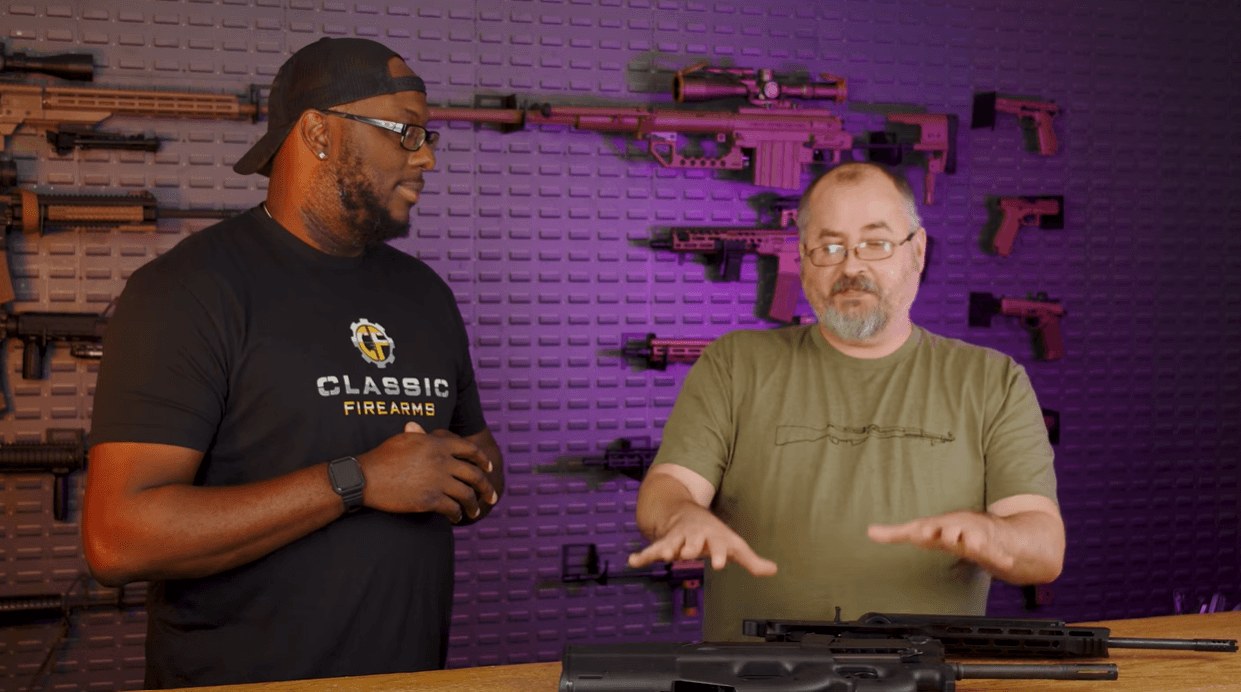
Classic Firearms hosts Matt and Jason spent a studio segment this week putting 5.7x28 in the pistol column. The video opens on the framing directly — "it's a rifle round" — and rejects it. Jason calls 5.7x28 "a pistol round," pointing to overall case length against 5.56 NATO, and Matt allows only that the design intent looks intermediate, because FN built the cartridge for a personal defense weapon and a handgun at the same time. His own qualifier follows immediately: the PDW is, in his words, effectively a submachine gun.
Both hosts trace the confusion to shape. The bottlenecked case with its necked-down projectile reads at a glance like the top of a 5.56 round. That, they argue, proves nothing about classification, and they list necked pistol cartridges that predate 5.7x28 by decades — .357 SIG and 7.62x25 Tokarev among them.
The velocity and energy trade-off, as the video frames it
The segment's ballistics case runs on a single comparison. The hosts put 5.7x28 at roughly 1,800 to 1,900 feet per second at the muzzle against about 1,100 for 9mm, then claim 9mm carries more energy at 100 yards than 5.7x28 produces at the muzzle, and that 5.7x28 sheds velocity faster — they estimate about 500 feet per second lost at 100 yards against roughly 100 for 9mm. Published comparisons of the two cartridges land in the same territory on velocity, commonly citing figures near 1,950 fps for 5.7x28 and 1,150 fps for 9mm, and on retention: 5.7x28 holds a materially smaller share of its energy at 100 yards than 9mm does.
Matt adds a caveat of his own. Advertised 5.7x28 numbers depend on what the load was tested in — the 10.5-inch barrel of a P90, the 16-inch PS90, or an AR57 upper — and the same cartridge posts different figures out of each. Jason adds that hotter commercial loads exist, citing ammunition he has clocked near 2,100 fps.
The hosts convert the trade-off into shooting terms rather than a verdict. Flatter trajectory and lighter recoil, Matt argues, raise practical accuracy because the shooter has less holdover to judge and less recoil to manage, which he separates explicitly from a firearm's inherent mechanical accuracy. The other direction of the trade is stated just as plainly: 9mm is heavier and wider, carries its energy farther, and delivers more of it to the target.
What the NATO record actually shows
The video's history section is broadly consistent with the public record. FN developed 5.7x28 as a proposed replacement for 9mm NATO, with P90 production beginning in 1990 and the Five-seven pistol following as a companion. Heckler & Koch answered with 4.6x30 for the MP7. NATO testing across 2002 and 2003 favored 5.7x28, and Germany's objection was enough to stall the standardization effort — the account Matt gives on camera.
“The disagreement is not really about case geometry — it is about which end of the velocity-versus-energy trade a buyer wants to stand on.”
Avery Lindqvist, The ReticleThe 2021 standardization went wider than the segment describes. When NATO did standardize 5.7x28 in 2021 under STANAG 4509, it standardized 4.6x30 in the same agreement, and neither cartridge displaced 9x19 as NATO's pistol round. Standardization recognized the calibers; it did not settle the replacement question the 2002 trials were convened to answer.
Armor-defeating loads and what is on the shelf
On body armor, the hosts qualify the claim on camera. Jason names soft-armor defeat as an advantage; Matt cuts in to clarify that the performance belongs to the original military specification fired from the 10.5-inch P90, and that commercially available ammunition is not the same projectile. That matches how the ammunition is actually distributed: FN's SS190, the load with the steel penetrator, is restricted from general civilian sale, while the commercial SS195LF, SS197SR and SS198LF loads use different projectiles that the ATF has not classified as armor-piercing.
Who is building 5.7x28 guns now
The closing argument is about market breadth rather than terminal performance. The hosts count FN, Ruger, Smith & Wesson, CMMG, Kel-Tec, Tisas and Masterpiece Arms among the companies now chambering 5.7x28, alongside AR-15 uppers like the AR57 that feed from 50-round P90 magazines and eject through the magazine well. Kel-Tec's PR57, which they describe as an internal-magazine pistol fed by stripper clips, gets singled out as the mechanically unusual entry. Matt argues that a cartridge roughly 30 years old is early in its lifespan, and that its manufacturer support suggests it stays.
Capacity and ergonomics carry the practical section. Jason notes 20 rounds in a Five-seven and 50 in a P90 magazine that he says weighs about what a loaded AR-15 magazine does. Matt, who shoots left-handed, walks through the PS90's ambidextrous controls — mirrored charging handles, a selector reachable from either side, a magazine release at the rear, downward ejection, and three iron sight options including a center peep. On price, both concede 9mm wins, while arguing 5.7x28 has come down as availability has grown.
For context
- FN developed 5.7x28 alongside the P90, which entered production in 1990; the Five-seven pistol followed as a companion weapon using the same cartridge.
- NATO trials concluding in 2002 rated 5.7x28 favorably against H&K's 4.6x30, but German objection halted the effort to replace 9mm NATO.
- STANAG 4509 standardized both 5.7x28 and 4.6x30 in 2021 as recognized NATO calibers; neither replaced 9x19 as the alliance's pistol cartridge.
- FN's armor-defeating SS190 load is restricted from general civilian sale; the commercial 5.7x28 loads sold to sport shooters use different projectiles.