Why it matters: The zero-dollar making tax took effect on January 1, and it quietly removed the main reason anyone bought a braced pistol instead of a registered short-barreled rifle. What the braced-pistol shelf is worth now is a live question for every budget manufacturer on it, and the PLR-16 is the oldest answer in the case.
Administrative Results published a review of the Kel-Tec PLR-16 on Thursday under the title "One in Every Evidence Locker," which is most of the argument in five words. The gun is 21 years old. Its receivers are polymer. The reviewer describes it as looking like a toy from a science-fiction movie, notes that it gets hot fast, breaks the pistol brace himself while wrestling a suppressor off it, and then says he likes the thing anyway. That combination is not a contradiction. It is a review of a category the industry mostly stopped selling.
The timing is what makes the video worth arguing with rather than simply watching. A 21-year-old plastic 5.56 pistol is a curiosity in most years. In 2026 it is a control group.
What the zero-dollar NFA stamp changed for braced pistols
The One Big Beautiful Bill Act, signed in July 2025, dropped the National Firearms Act making and transfer tax to zero for suppressors, short-barreled rifles, short-barreled shotguns and any-other-weapons, effective January 1 of this year. Machine guns and destructive devices still carry the 200-dollar tax. The demand was not theoretical: ATF's electronic filing system took roughly 150,000 submissions on the first day the tax went away.
The tax is gone. The process is not. A Form 1 build still requires an approved registration before the gun exists, still runs a background check, still ties the receiver to a registry entry that follows it for the rest of its service life, and still brings the interstate-notification chore that comes with an NFA firearm. Separately, the brace itself came out of legal limbo from the other direction: a federal court in the Northern District of Texas vacated ATF's 2023 stabilizing-brace rule in June 2024, and the Justice Department dismissed its appeal in July 2025, which ended the realistic path to enforcing it.
So the braced pistol's decade-long sales pitch has lost a leg. For years the pitch was three things at once: something close to a short rifle, no 200-dollar tax, no registration and no wait. The tax is now worth nothing as an argument. What survives is the paperwork and the permanence, which are real considerations and considerably thinner ones. Everything on that shelf now has to be justified as a gun rather than as an arrangement.
The PLR-16 predates the workaround entirely
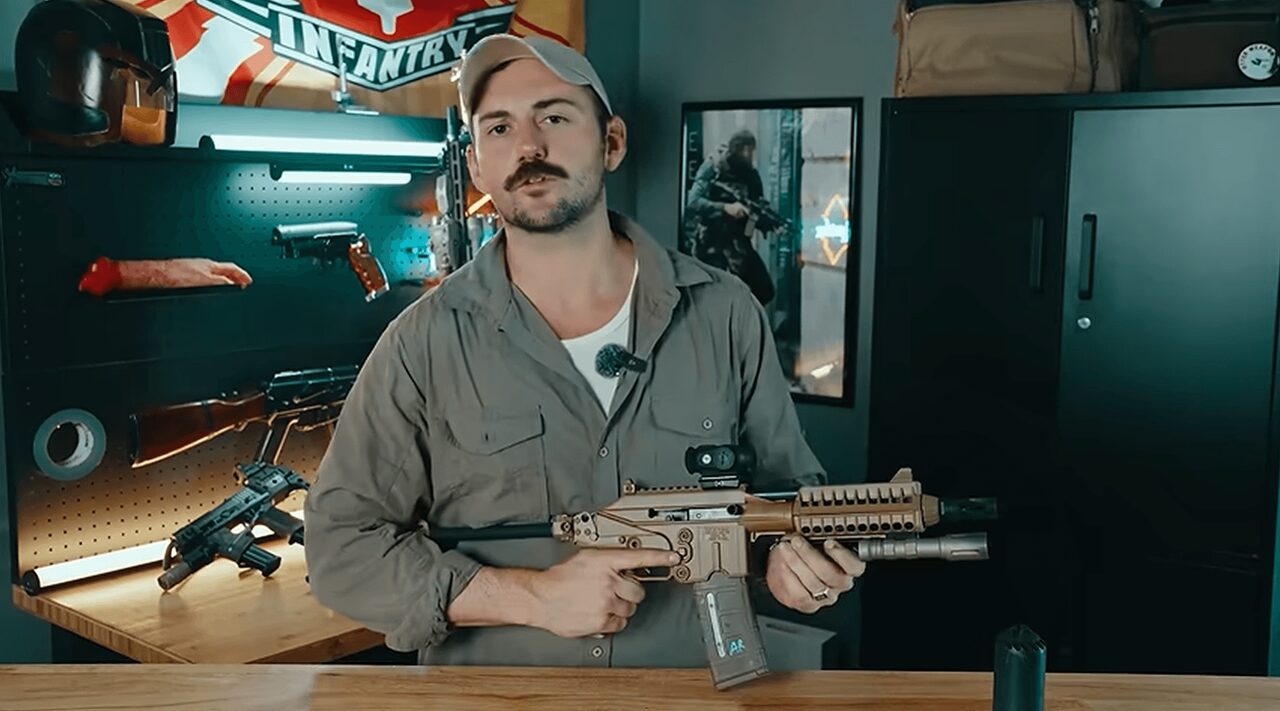
This is where the PLR-16 gets interesting rather than merely odd. Kel-Tec introduced it in 2005, roughly seven years before pistol braces existed as a commercial product. George Kellgren designed it as a pistol-scaled sibling to the SU-16 carbine: a long-stroke gas piston, a 9.2-inch barrel with 1:9 twist and 1/2-28 threads, AR-pattern locking lugs and AR magazines, polymer upper and lower, 18.5 inches overall, and 3.4 pounds unloaded. Kel-Tec now sells a Defender package built around it with a Viridian red dot, a Strike Industries brace, an adapter and a Magpul angled grip; the reviewer paid 889 dollars for a comparable bundle, and street prices for the package tend to run lower than that.
Nothing in that design was a response to a rule. It was a pistol because someone wanted to build the lightest thing that would throw a 5.56 projectile, and the market for that has always been thin. Subtract the legal arbitrage from the braced-pistol shelf and most of what remains is an AR pistol that wishes it were an SBR. Subtract it from the PLR-16 and you get the PLR-16, unchanged, because it was never leaning on the arbitrage in the first place.
Cost of loss is the specification nobody prices
“Cheap here is neither a compliment nor an insult. It is a tolerance for loss, and it is the one specification the premium market has refused to sell.”
J.D. Whitfield, The ReticleThe review's real content is not accuracy or ergonomics. It is a sustained argument about what you are willing to lose. The reviewer's own use case is the side-by-side, the bush plane, the pack you take somewhere wet: a gun that can absorb scratches, dings and neglect because replacing it does not hurt. That is a specification. It is also one the premium end of the market has systematically refused to sell, because a PDW-class truck gun in 2026 starts north of two thousand dollars and every dollar above the first eight hundred buys durability you have then made yourself too nervous to test.
The video is honest about the costs of buying at the bottom, which is why it is usable. Roughly a thousand rounds of 55-grain plinking ammunition produced one or two stoppages. The brace snapped, though by the reviewer's own account he broke it torquing a suppressor free rather than shooting it. There is a bolt hold-open on the magazine but no bolt release, the controls are not ambidextrous, and reassembly after a strip is fiddly enough that he says so directly. Kel-Tec advises against suppressing the gun at all, and the reason is specific rather than legalistic: conventional back pressure flexes the polymer receiver, which is exactly why the flow-through can he chose is the configuration that tends to survive.
Asked the only question that matters, he answers it plainly and against his own affection for the gun. He would not stake his life on a PLR-16 if something better were in the safe. A reviewer who will say that out loud has earned the rest of his enthusiasm.
The showbiz build and the one he would actually carry
The most useful thirty seconds in the video are the ones where he admits the configuration on camera exists for the thumbnail. The red dot, the can, the angled grip and the rail clutter are there to sell the click; the gun he says he would actually carry is the brace and the low-mounted iron sights and nothing else. Gear media does not usually show its own seams that clearly, and the admission does more for the argument than any group size would, because the slick version is the one where the light weight is the whole point.
None of this makes the PLR-16 a good rifle. It is not competing with rifles and never was. What it does is occupy the one slot the industry has spent a decade pricing out of reach, and it occupies that slot without needing a rule to explain itself. Now that the tax is zero, everything else on the braced-pistol shelf has to make the same case on the same terms, and most of it was not designed to.
For context
- The NFA making and transfer tax on suppressors, short-barreled rifles, short-barreled shotguns and any-other-weapons dropped to zero on January 1, 2026 under a provision of the One Big Beautiful Bill Act signed in July 2025; machine guns and destructive devices still carry the 200-dollar tax, and registration and background checks are unchanged.
- ATF's 2023 stabilizing-brace rule was vacated by the Northern District of Texas in June 2024, and the Justice Department dismissed its appeal in July 2025, leaving braced pistols treated as pistols under federal law.
- Kel-Tec introduced the PLR-16 in 2005 as a pistol-length relative of its SU-16 carbine: 9.2-inch barrel, long-stroke gas piston, polymer receivers, AR magazines, 3.4 pounds unloaded.
- Kel-Tec's own guidance advises against running a suppressor on the PLR-16, and owners report that high back pressure flexes the polymer receiver, which is why flow-through designs are the common workaround.
Themes in the source
Room for disagreement
A gun you would not bet your life on is not a bargain at any price, and the video supplies the evidence itself: a brace that snapped in ordinary handling, stoppages inside a thousand rounds, a receiver the manufacturer says will flex under a normal suppressor, and a takedown the reviewer calls awkward enough to matter if it ever counted. That is one sample, tested on a flat range, with plinking ammunition, at short distance. Set against it, the same 700 to 900 dollars buys a used 16-inch carbine that is better in every measurable way, and the zero-dollar stamp cuts the other direction too: a Form 1 on a quality host now costs nothing but time, which makes the whole braced-pistol premise harder to defend rather than easier. "Light and disposable" is also how people talk themselves into carrying a tool that fails at the one moment it is asked to work, and calling the resulting compromises charming is how a review stops being a review.
The bottom line
The PLR-16 will lose any comparison against a real carbine, and it does not need to win one. With the tax at zero, the braced pistol can no longer sell itself as a way around 200 dollars, which leaves the budget end of the market arguing about what you are willing to lose. That is the argument the PLR-16 was built for, 21 years before anyone needed it to be.