Why it matters: Movie guns are how most people meet the guns they later collect, and the Indiana Jones films are a working museum of early automatic and service arms. This video is a guided tour of that collection, and of the places where the props and the history part company.
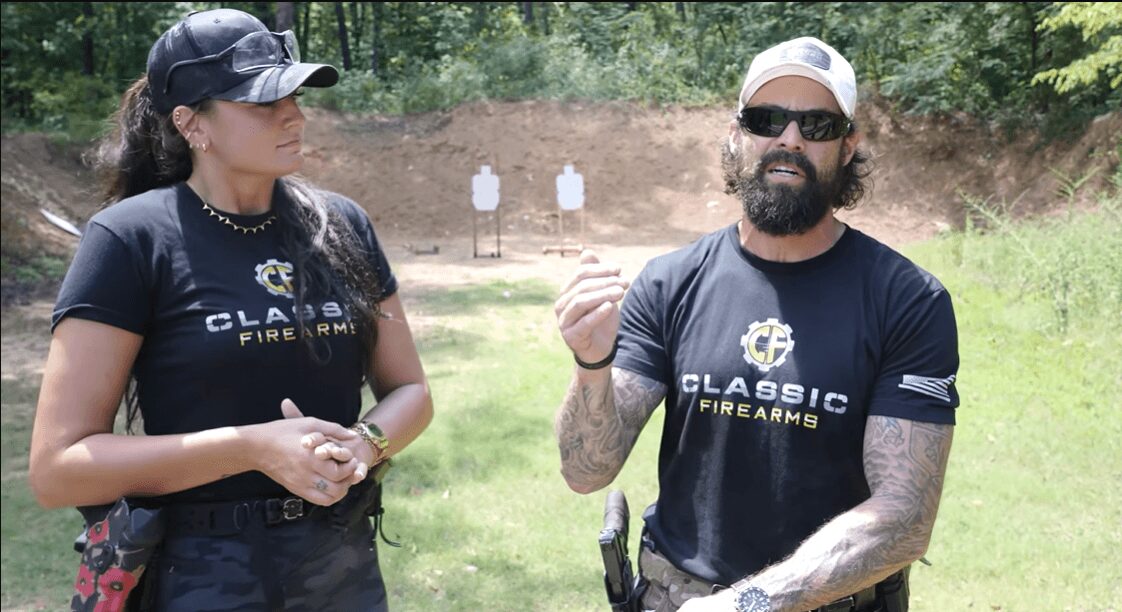
Classic Firearms, the online retailer, has posted a countdown of what its host considers the five most significant firearms in the Indiana Jones franchise. The host, identified on camera as Matt, gives each entry a short design history, names the scene it appears in, and adds an honorable mention for a weapon that is not a gun at all. The list runs from the MP40 submachine gun at number five to the Smith and Wesson M1917 revolver at number one.
The countdown is a history segment rather than a product review, and the host says early that the movies are not a reliable record of what anyone carried in 1936. He returns to the point at several entries.
The list, from the MP40 to the M1917 revolver
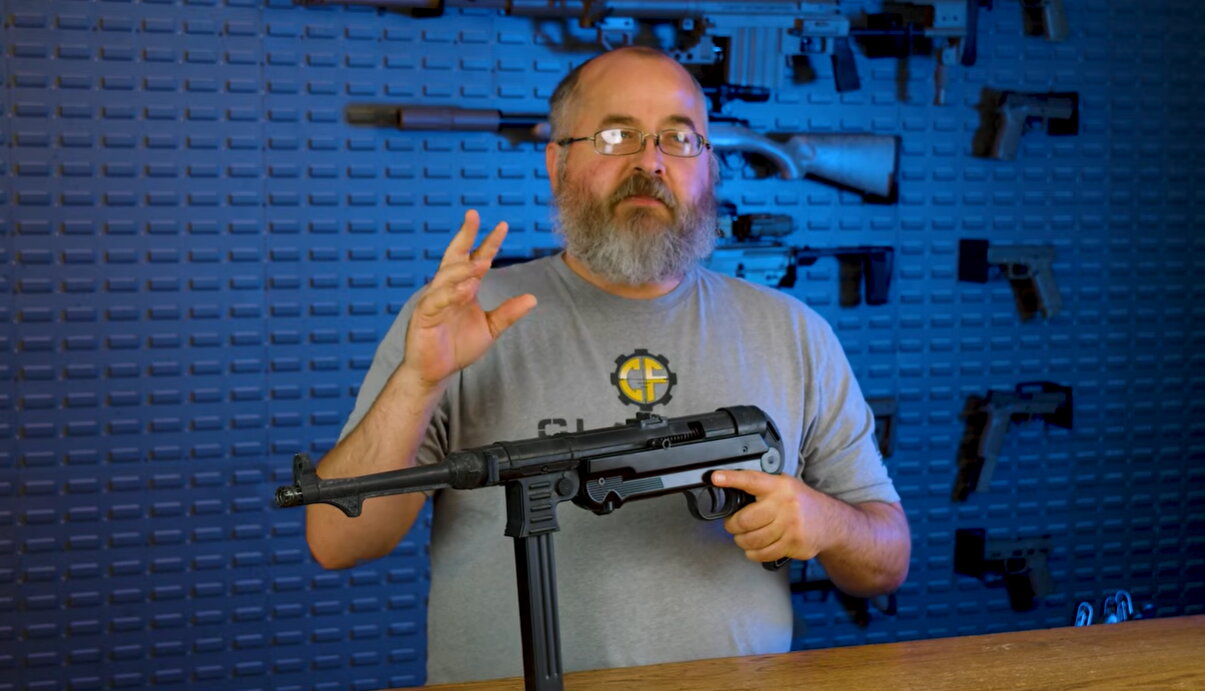
At number five, the MP40. The video traces it through the MP36 and MP38 as an exercise in getting cheaper and faster to build, with stamped sheet-metal construction replacing the wood and machining of earlier guns. It is a direct blowback design in 9mm, and the example on the table is an ATI-imported semi-automatic pistol variant with no stock. He credits the design with influencing the simplicity of the M3 grease gun, and says the folding stock was carried over more or less intact to the Kalashnikov pattern. He also flags the anachronism directly: Raiders of the Lost Ark is set around 1936 and The Last Crusade around 1938, and the MP40 did not exist yet in either year.
Number four is the C96, the broomhandle Mauser. The video covers the internal magazine forward of the grip, loaded through the top from stripper clips in 10 and 20-round capacities, the 7.63x25mm Mauser cartridge, and the short recoil action. More than a million were built and the pattern was copied widely in Spain and China. The host notes Winston Churchill's account of carrying one as a young officer, and the scene in Raiders in which Marion Ravenwood pulls one on German visitors to her Nepal bar. He adds that German troops found their 7.63mm ammunition would run in captured Soviet arms chambered for the dimensionally similar 7.62x25mm Tokarev.
The Walther P38 and the double-action timeline
Number three is the Walther P38, adopted to replace the P08 Luger and, the host says, still confused for one by people who know both by silhouette only. He walks through the falling locking block, comparing it to the wedge under the barrel of a Beretta 92, and through the double-action-to-single-action trigger with a decocking safety. The video calls the P38 the first pistol built that way.
That claim needs a date. Walther's own PP, introduced in 1929, already paired a double-action-to-single-action trigger with a decocking safety, in a straight blowback frame. What the P38 is generally credited with is putting the arrangement into a locked-breech military service pistol first, which is the version the record supports. The scene the host attaches to it is the tank sequence in The Last Crusade, where one shot from the P38 accounts for three pursuers.
Number two is the Haenel MP28/II, Hugo Schmeisser's interwar revision of his own MP18 of 1918. The significant change was the feed: out went the 32-round Luger snail drum entering at an angle, in came a straight box magazine of Schmeisser's design entering at ninety degrees. The host calls the MP18 the first genuinely effective submachine gun, and traces the family tree that follows: the Finnish Suomi M/31, then the Soviet PPD and PPSh-41, and the British Lanchester, which copied the German gun closely enough to accept its magazines, and from there the Sten. Japan's Type 100 studied the same design. On screen, it is the gun carried by the Brotherhood of the Cruciform Sword in the Venice speedboat chase in The Last Crusade.
“The list is really two histories running side by side: what the guns were, and what the movies needed them to look like.”
Tess Marlowe, The ReticleThe honorable mention is the RPG-2, described as the Soviet answer to the Panzerfaust and the M1 bazooka: a 40mm tube throwing an 82mm warhead to roughly 150 meters, with about 180mm of armor penetration. It is what Indiana Jones shoulders on the ridge when he threatens to destroy the Ark. The RPG-2 reached Soviet service in 1949, thirteen years after the film's setting, and the prop is further removed still. Simon Atherton, the production's armorer, has said the launcher was a Chinese Type 56 copy of the RPG-2 dressed to read as a German wartime weapon.
Indiana Jones's revolver and the two props behind it
The number one pick is the M1917 in .45 ACP, specifically the Smith and Wesson version. The video explains the procurement problem behind it: with the 1911 adopted but in short supply during the First World War, the Army asked Smith and Wesson and Colt to adapt their large-frame revolvers to .45 ACP so sidearm production and ammunition logistics could run on one round. Smith and Wesson built theirs on the .44 Hand Ejector Second Model, Colt on its New Service. Because .45 ACP is rimless and a revolver normally headspaces on a rim, Smith and Wesson introduced the half-moon clip, which holds three rounds by their extractor grooves and gives the ejector star something to push against. The Smith and Wesson version also cut a step into each chamber so the cartridge headspaces on the case mouth rather than on the clip.
Two revolvers were used in filming, the host says: one with the barrel cut from five inches to four and a band added at the front sight, no medallions in the grips and a chip in the left panel, used for handling shots like Jones packing his suitcase, and a second with grip medallions used for the firing scenes, chambered not in .45 ACP but in .455 Webley. That matches what prop houses and auction listings describe, a Smith and Wesson Mark II Hand Ejector in .455 with a shortened barrel, supplied to the production by the British armorer Bapty and Company.
He closes with the Cairo swordsman, the scene most often attached to the revolver, repeating the long-reported account that it was written as an extended sword fight and cut short because Harrison Ford was ill that day. The video ends by asking viewers what the list missed.
For context
- The MP40 entered German service in 1940, after the settings of both Raiders of the Lost Ark and The Last Crusade, and film armorers have long used it as visual shorthand for German troops of the period.
- Half-moon clips, introduced with the M1917, let rimless .45 ACP headspace and eject in a revolver cylinder; the six-round full-moon clip is the same idea and is still in production today.
- The MP18 and MP28 line is the common ancestor of most Second World War submachine guns, including the Suomi M/31, the PPSh-41, the Lanchester and the Sten.
- Classic Firearms is an online retailer whose YouTube channel mixes product videos with history segments like this one.