Why it matters: Load-bearing vests are standard issue today, but the pattern started as something soldiers paid for themselves. This video puts three surviving Vietnam examples on the table and dates one of them by the mail bag sewn inside it.
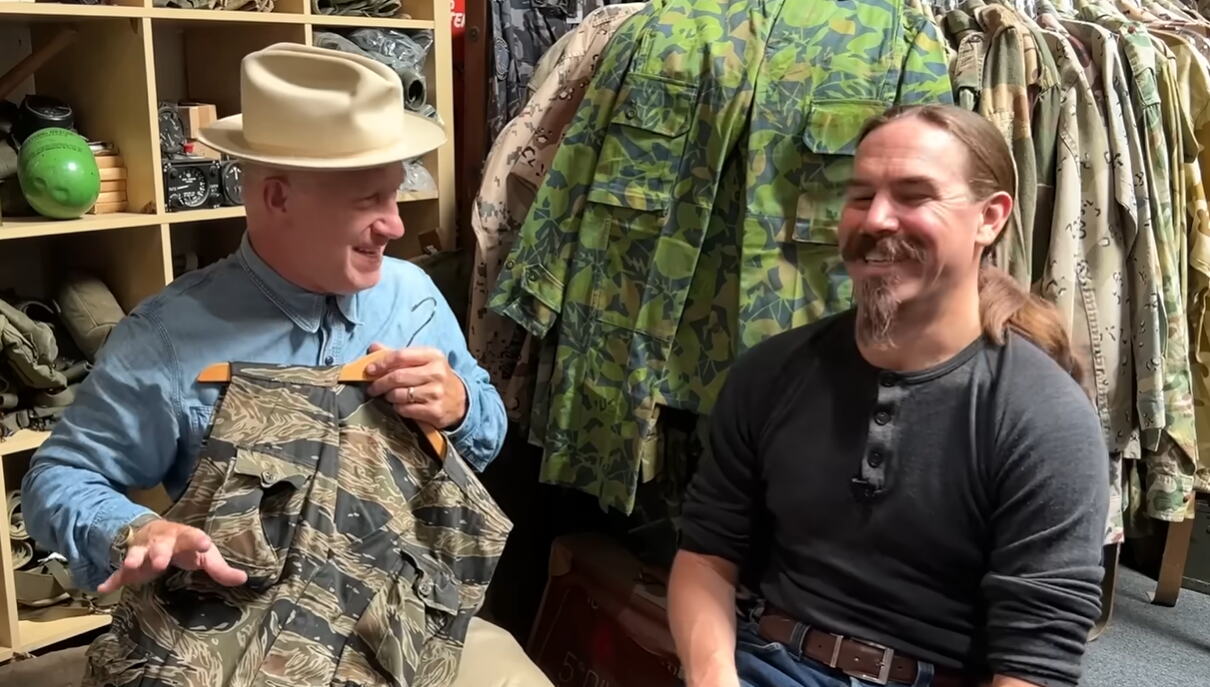
Forgotten Weapons published a video on August 4 in which host Ian McCollum and Owen Thornton, author of the forthcoming Headstamp Publishing book "Tiger Stripe: The Vietnam Camouflage Story," examine three combat vests made in-theater during the Vietnam War. None of the three was an issue item. All were made to order, most of them in tailor shops.
Thornton opens with the lineage. Combat vests, he says, appeared in a limited way in World War I — German body armor first, then American grenade vests for trench assaults — and carried through to the World War II assault vest. In Vietnam, by his account, the custom-vest tradition returned in full: men went to tailor shops and asked for ammunition-bearing vests "because there was nothing on issue."
No issue standard, so every camouflage pattern got a vest
Because nothing was issued, Thornton says, vests were made in every camouflage pattern then in circulation — ERDL, leaf, what he calls the police pattern, and tiger stripe. "The standard is there is no standard," he says.
The first vest shown carries rows of front pockets. McCollum reads them as grenade pockets; Thornton says they work for grenades or for a 20-round magazine, and notes that 20-rounders were what a rifleman carried at the time. Thornton also flags something he says collectors overlook: to a soldier in the field, all camouflage was camouflage. Worn trousers, a new shirt and a boonie hat in a different pattern went together without comment, and the same indifference shows up in the vests, whose pocket material often does not match the body.
A 1968 US mail bag inside the lining
The dating evidence on that first vest is literal. Its liner is cut from US mail bag canvas, and the lettering is visible in reverse through the fabric, along with a 1968 date. Thornton says the American canvas was better than what was available locally and was traditionally used for linings; he describes the bags as procured. Whatever the route, the stamp puts the vest at 1968 or later — a firmer date than most field-made gear ever gets.
An aviator's vest cut from a bolt of cloth
“A mail bag stamped 1968 does more dating work than most surviving paperwork.”
J.D. Whitfield, The ReticleThe second vest, which Thornton dates slightly earlier, came from the estate of a US Air Force veteran and was built around mission gear rather than ammunition: pen flares, a signal mirror, flat water sachets, rations, with additional pockets on the back. McCollum notes the pockets are styled like those on the jungle uniform. Thornton's point is that they were not salvaged from a set of tiger stripe trousers — they were cut from scratch, which tells historians the tailor had a bolt of the cloth on hand. The vest also opens from the bottom rather than the top, which Thornton attributes to the wearer's own preference.
Asked whether a standardized camouflage vest ever emerged before the end of the war, Thornton says no. The standardized items, he says, were the US Air Force survival vest — which he refers to in the video as the "27P" — and a heavy canvas vest known as the 1-0 vest, after the designation for a reconnaissance team leader. That one, by his account, was not bought but awarded by the team. Everything else was a walk into a tailor shop, and Thornton says fabric was widely available on the black market in Saigon, in Japan and in most towns and villages.
The video is tied to a Kickstarter now funding
The video closes on the book. All three vests appear in "Tiger Stripe: The Vietnam Camouflage Story" in more detail, Thornton says, along with others not shown on camera. The Headstamp Publishing campaign is live on Kickstarter from July 30 to August 28; public backer-tracking listings put it past its $40,000 goal at roughly $89,800 from 359 backers. Headstamp describes the book as a hardback photographed by James Rupley, carrying more than 1,250 images and covering the pattern's variants from the French-derived Lizard through the later Vietnamese and American renditions.
For collectors, the value of the three vests is in how little they have in common. Each one was specified by the man who wore it, and each one records a decision — where the magazines go, which way the front opens, what the lining was cut from.
For context
- Tiger stripe descends from the French "Lizard" camouflage worn in Indochina, and was later adopted by South Vietnamese units and the US advisors working with them.
- ERDL is the US Army leaf pattern designed in 1948 that became the standard jungle camouflage later in the war.
- The standard US Air Force aircrew survival vest of the period is designated SRU-21/P; Thornton refers to it in the video as the "27P."
- In MACV-SOG, "1-0" designates a reconnaissance team leader; surviving 1-0 vests are olive-drab canvas with six front pockets.