Why it matters: Every belt-fed light machine gun a Western soldier has carried for forty years has had a quick-change barrel. FN built one that doesn't, and it is now being bought in quantity by at least one NATO army — which makes the reasoning worth hearing in full.
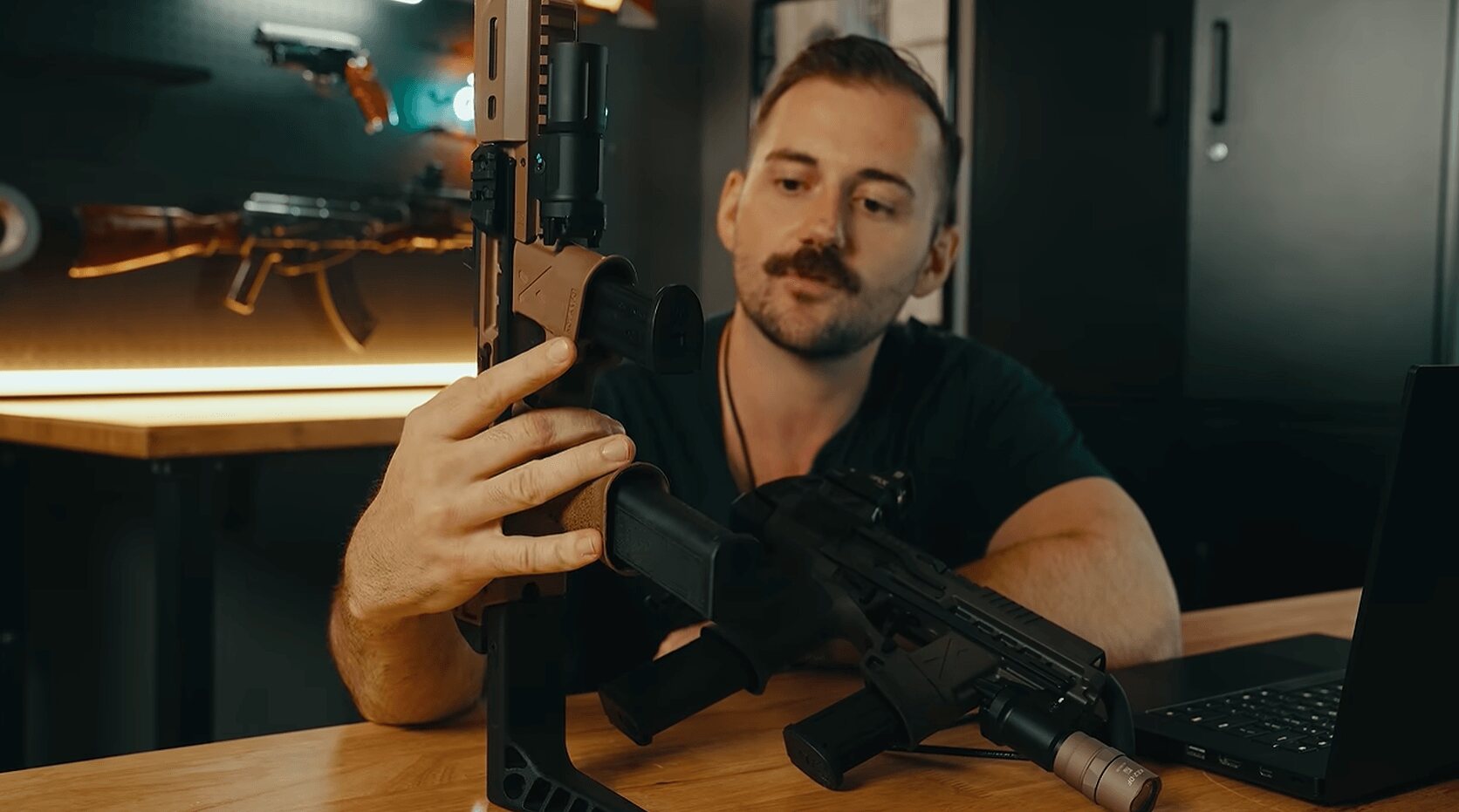
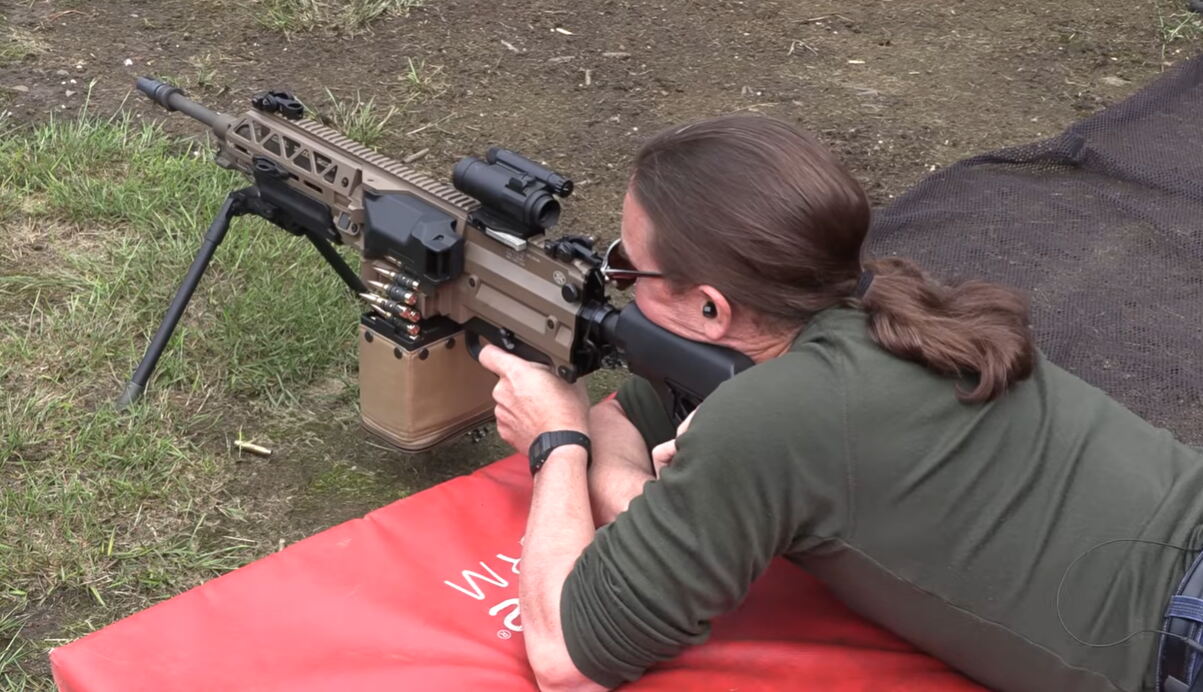
Forgotten Weapons published a video on August 5 in which host Ian McCollum disassembles and fires FN Herstal's Evolys machine gun in both 5.56x45mm and 7.62x51mm at the company's facility in Belgium. FN hosted the visit, which McCollum states on camera. The video covers the design brief FN says produced the gun, a complete strip of the 5.56mm version, and short range segments in both calibers; the full-auto footage is not on YouTube, and McCollum directs viewers to Pepperbox and Patreon for it, citing platform rules.
The gun's defining characteristic is what it does not have. The Evolys is belt-fed and open-bolt, and its barrel is fixed. McCollum calls that unusual by current standards and says FN arrived at it deliberately.
Why the FN Evolys has no quick-change barrel
By FN's account as relayed in the video, the project began around 2015 with two sets of customer requests arriving from opposite directions — one for an infantry rifle capable of more sustained fire, in the mold of the M27 IAR or the Browning Automatic Rifle, and one for something like a Minimi but substantially lighter. FN decided the overlap justified a new design rather than a variant, with the brief set as maximum firepower at minimum weight.
The company then asked prospective buyers how they were actually using the guns they had, according to McCollum: how much ammunition went out on a mission, and whether a spare barrel went with it. FN's reported finding was that a significant number of units carried roughly 600 to 1,000 rounds for the machine gun and that many were not carrying a spare barrel at all — or were carrying one fitted with a suppressor, swapping for sound signature rather than for heat. On that usage pattern, the quick-change mechanism is weight spent on a capability the unit does not exercise.
McCollum notes the precedent: the Soviet RPD and RPK and the Finnish KvKK 62 were all squad automatics without interchangeable barrels. The Evolys barrel is not sealed in — FN describes it as easily changeable rather than quick-change, held by a single fixation screw and intended to be swapped at armorer level when worn, not in the field. McCollum cites 5.6 kilos for the 5.56mm gun and 6.3 kilos for the 7.62mm; FN's own product page lists the 5.56mm version at approximately 5.5 kilos.
Fixed optics rail, side feed, and a hydraulic buffer
The rest of the design follows from the same two goals, weight and accuracy. The receiver is a single aluminum casting produced by a lost-wax process, carrying a fixed full-length Picatinny rail — so the optic does not sit on a hinged top cover that has to be opened to load or clear. To free that rail, FN rotated the feed cover roughly 45 degrees to the side and shortened it by about half, moving part of the feed function onto the bolt carrier itself: the cam track that converts bolt travel into lateral belt movement now lives on the carrier rather than in the cover.
McCollum singles out the feed tray component as manufactured additively in series production rather than as a prototype, with the print layers oriented to strengthen the finished part. He says it is the first production-component use of additive manufacturing he has seen in a firearm outside of prototyping.
“FN's argument is not that the quick-change barrel is useless, but that a large share of buyers were already not using it.”
J.D. Whitfield, The ReticleThe action is a short-stroke piston, which McCollum describes as a scaled-up version of the SCAR gas system, with a single gas port and no adverse setting. FN's stated position is that the gun carries enough reserve operating energy that no second setting is needed, including with modern flow-through suppressors. That reserve is absorbed by a hydraulic buffer built into the side of the bolt carrier, which McCollum says brings the cyclic rate down from roughly 850 rounds per minute to roughly 750. FN told him the buffer was among the hardest parts of the program — early versions had a high failure rate, and fixing it delayed the gun's public introduction.
Other details from the strip: a three-position ambidextrous selector with safe, semi and automatic, where the Minimi has no semi-automatic position; a two-lug rotating bolt with one extractor and two plunger ejectors in both calibers; steel guide rails screwed into the aluminum receiver so the working parts do not wear on it; and an AR-pattern buffer tube at the rear that holds no operating parts and exists only to accept commercial stocks. McCollum says FN is finishing development of its own folding stock for the same interface. Barrel lengths are 14 inches in 5.56mm and 16 inches in 7.62mm, one length per caliber.
Where the Evolys sits, and who is buying it
FN's positioning, as stated in the video, is that the Evolys replaces neither the Minimi nor the MAG. It is pitched as a third thing between a rifle and a full-capability light machine gun with quick-change barrels and tripod mounting — aimed at units moving light and fast, which in practice means special operations first.
The gun is not new to the market. FN unveiled the Evolys in May 2021, and procurement has moved since. France's DGA signed an order with FN Herstal for several thousand Evolys and Minimi Mk3 machine guns at Eurosatory in Paris in June 2026; French and Belgian coverage of the signing reported an initial tranche of more than 2,000 weapons across models, with Belgian defense minister Theo Francken quoted saying up to 5,000 Evolys could follow in successive tranches. Exact quantities and contract value were not disclosed.
On the range, McCollum fired both calibers semi-automatically and described the 5.56mm gun as extremely soft-shooting from the bipod and the 7.62mm as a longer push rather than a sharp recoil impulse, which he attributes to the heavy reciprocating mass. He reports no noticeable gas coming back at the shooter. The video contains no round count, no sustained-fire testing and no accuracy data.
For context
- FN Herstal's two established machine guns are the Minimi, fielded in US service as the M249, and the MAG, fielded as the M240; both use quick-change barrels.
- The Evolys was unveiled in May 2021, so the video documents a maturing product in procurement rather than a launch.
- A quick-change barrel exists to sustain fire past the point where one barrel overheats, which matters more to a tripod-mounted support gun than to a patrol carrying a fixed ammunition load.
- The visit was arranged and hosted by FN, and the full-auto portion of the video sits behind Pepperbox and Patreon rather than YouTube.