Why it matters: Forced reset triggers spent four years in federal litigation and came out of it legal in most of the country, and the argument over what they are actually for is still open. This video makes that argument from terminal performance rather than from rights.
Colion Noir published a 13-minute video on July 31 arguing that forced reset triggers have a defensive application he had not previously considered: stopping a charging bear. The video builds from a widely circulated clip in which a man hits a charging bear with a rifle round and the animal keeps coming. Noir does not identify the clip's source, location or date, and uses it only as the premise for a question — whether the conventional answer to a charging bear, one well-placed round from a large-caliber gun, is the right answer at all.
The video is an argument, not a test. It carries no range footage of the proposed setup, no timed drills, no terminal data and no gel work. Noir states repeatedly that he is asking rather than concluding, and closes by inviting viewers to tell him the ballistics do not hold up.
The volume-of-fire argument for forced reset triggers
Noir's case starts with a clock. A grizzly at full sprint, he says, moves somewhere around 35 to 40 miles an hour, which he converts to roughly 20 yards per second, leaving about three seconds to see the animal, accept that the charge is real, mount the gun and stop it. He flags his own arithmetic as approximate, calling it "a little bit of bro science."
From there the argument turns on target size. A bear at close range, in his framing, is not a marksmanship problem — it is "a refrigerator with teeth" that a shooter physically cannot miss. Shot placement matters, he argues, only because shooters are trying to make a small number of rounds do a large amount of work. Put ten to fifteen rounds into the animal in the time it takes to close the distance, and the problem stops being about precision.
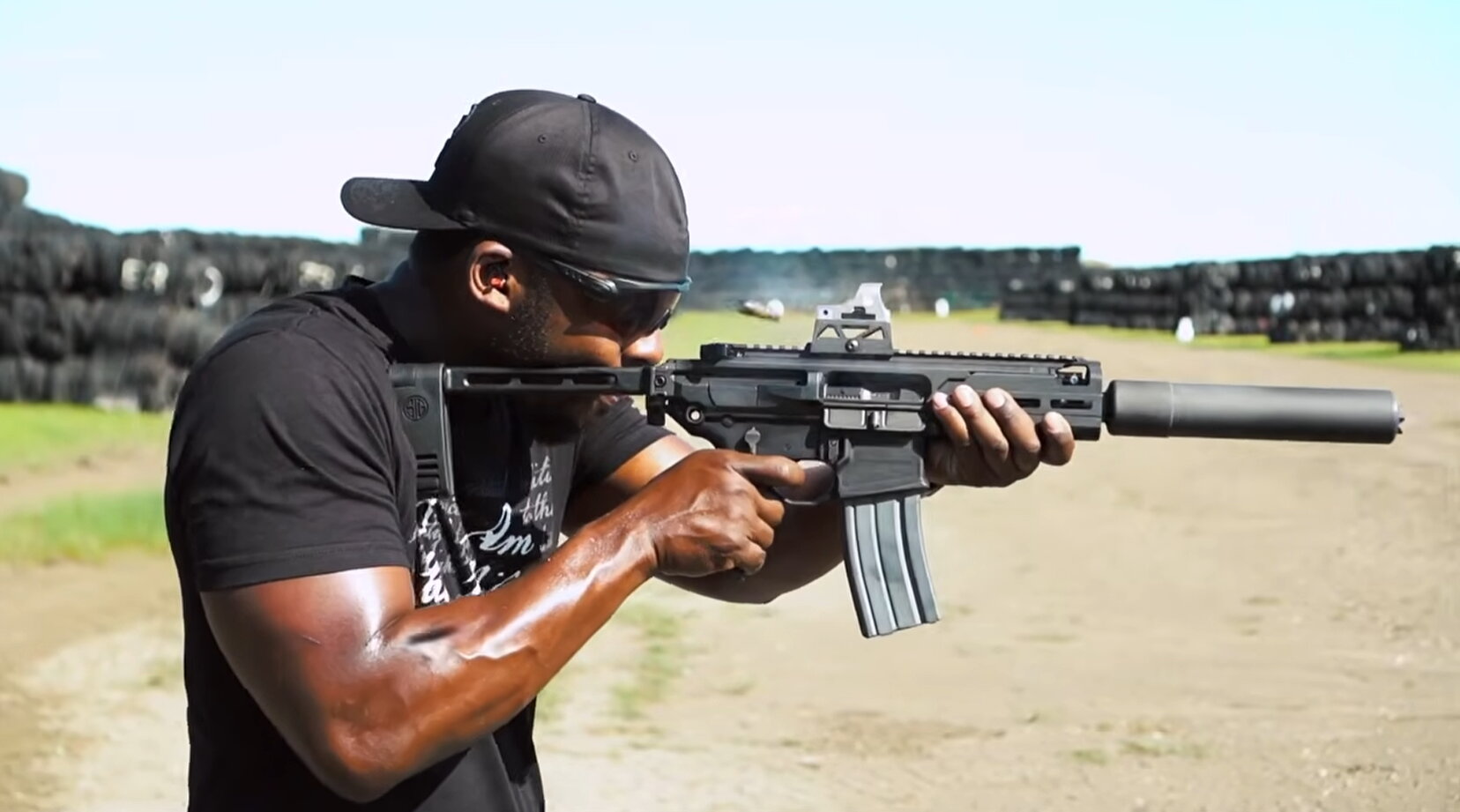
That, he says, is the entire function of a forced reset trigger: "it takes your finger and it multiplies it." His preferred configuration is a SIG Sauer MCX Rattler in 300 Blackout, suppressed, with a Rare Breed FRT installed — a 30-caliber rifle round, as he describes it, in a package roughly the size of a large handgun. He says he has seen the combination run and that what impressed him was control: short bursts on a press-and-release cadence rather than a magazine dump, though he adds that a magazine dump would also work on a target that size.
How the argument breaks from Noir's earlier positions
Noir has made a public case for FRTs before, and he draws the distinction himself. That argument was about human threats — suppressive fire, and the calculation an intruder makes when several rounds arrive quickly. He states plainly that the reasoning does not transfer: a bear is not performing risk assessment and does not disengage because the encounter got loud. What remains, in his words, is "physics and volume."
The video also revisits his own bear-gun history. He carried a Glock 20 first, then moved to the FN 510 Tactical, which he credits with 22 rounds instead of 15, a slimmer grip, a better trigger and a red dot. The underlying reason for the switch, he says, is that he shot the Glock 20 badly — something he demonstrated publicly in a video roughly five years ago and replays here. He notes that the poor performance came on a static range with no adrenaline and nothing closing distance.
That episode supplies the video's central concession: he solved a shooting problem by buying a gun he shot better and never examined the assumption underneath it, which was that a charging bear is answered by one good shot. He says the 510 remains his bear gun. He also cites an earlier instance of the same instinct, carrying a SIG MCX Virtus short-barreled rifle in 300 Blackout on a bison hunt while others around him ran bolt guns in larger calibers.
The penetration objection Noir raises against himself
“The question the video asks is not which round is better, but how many rounds fit inside three seconds.”
Avery Lindqvist, The ReticleNoir states the hunters' counterargument before his commenters can: that 300 Blackout on a large bear is inadequate, that penetration through hide, fat and shoulder bone is the whole question, and that subsonic loads in particular will stall in tissue without reaching anything that stops an animal. His response is that this may be entirely correct and that he has no field data on it. He notes he has hunted hogs, elk and bison, and has never been charged by a grizzly.
The video ends on the question rather than an answer: twelve rounds of 300 Blackout supersonic in two seconds, against one larger round or a few rounds of 10mm. Noir does not claim to know which one works.
One practical consequence he does raise is noise. An FRT multiplies muzzle blast along with rounds, and a dozen shots from a short barrel in under two seconds is a different exposure than a single shot. That observation leads into a segment on electronic earplugs he says he beta tested for over a year and now sells in his own store; he discloses the commercial relationship on camera. The video also promotes his apparel line.
Where forced reset triggers stand legally
Noir's closing framing is that the tool "exists and is legal" while people argue there is no reason for it. That tracks the federal picture. The Justice Department settled its FRT litigation with Rare Breed Triggers and the National Association for Gun Rights in May 2025, dropping its appeals, dismissing the forfeiture case, returning seized devices and agreeing not to enforce federal machine gun statutes against FRT possession or transfer, provided the devices function as described in the district court record. The non-enforcement agreement carves out FRTs designed for handguns.
Federal legality does not settle the question everywhere. Roughly a dozen states and the District of Columbia restrict FRTs under multiburst trigger activator or rate-of-fire statutes enforced independently of federal law, which means the configuration Noir describes is not available to every viewer watching him describe it.
The Reticle has not tested any of the setups discussed and reports none of the above as verified performance.
For context
- A forced reset trigger uses the firearm's own cycling action to mechanically push the trigger forward after each shot, raising the practical rate of fire while still firing one round per trigger pull.
- The ATF classified Rare Breed's FRT-15 as a machine gun in 2021, triggering four years of litigation that ended in a May 2025 Justice Department settlement reversing federal enforcement.
- Roughly a dozen states and the District of Columbia still prohibit forced reset triggers under state multiburst trigger activator laws, regardless of the federal settlement.
- Conventional bear-defense guidance centers on bear spray or a large-bore firearm and treats a single well-placed shot as the objective, which is the assumption this video sets out to test.