Why it matters: Colion Noir has spent months arguing that rate of fire, not shot placement, is the right answer to a large animal at close range. A viral moose clip has now become the centerpiece of that case, and a forced reset trigger is the hardware at the end of it.
Colion Noir has published a video arguing that warning shots do not work on wild animals and that the practical answer to a large animal at close range is volume of fire delivered through a forced reset trigger. The video is titled "This Moose Didn't Care About Warning Shots. That's Why FRTs Matter," and it is built around third-party footage of a man emptying most of a magazine into the dirt to drive a moose off his property.
In the clip Noir plays, the man fires round after round into the ground while shouting at the animal to leave. The moose does not leave. The sequence ends with the man saying he has run out of bullets. Noir describes the animal's reaction as though the encounter were buffering.
What the moose footage shows, and what it does not
Noir supplies context for the clip from what he says is the poster's own page: the moose has been coming onto the man's property repeatedly over a stretch of time, he has named her, and he wants her gone because an animal that comfortable around people does not survive long term. Noir characterizes the man as trying to end the relationship rather than as someone ambushed on a trail.
He is explicit about the limits of what he knows. The post reads to him as though the moose was advancing, but he says he cannot confirm that, and that she may simply have been standing there. He argues the uncertainty strengthens rather than weakens his point: an animal with no food motive, no calf to defend and nothing to gain is the easiest case a warning shot will ever have to clear, and close to a full magazine did not clear it.
The Reticle could not independently identify the original moose footage or verify the account of the property owner's history with the animal. Both come from Noir's video.
How the bear and cougar videos set up the argument
The moose clip lands inside a run of videos Noir has been making on the same theme. He points back to a video in which a man with a full-powered rifle got a solid hit on a charging bear and the bear kept coming, which he says is the point at which he stopped treating the problem as one of shot placement. He points to a second video about a cougar, where he says commenters repeatedly proposed a warning shot as the answer to an apex predator sizing up a person.
His objection to the warning shot is that the animal has no framework for it. A wild predator does not know what a gun is, so pointing one means nothing, and a gunshot registers as a sound with nothing attached to it, closer to a car door or a firework two streets over. The best outcome he says noise buys is a confused animal, and he draws a distinction between confused and leaving.
Noir also plays footage of a different moose displaying the pre-charge sequence: side eye, ears flattening, then licking its lips. He frames that sequence as the last free information a person gets, and says the window that follows is roughly two seconds wide.
The forced reset trigger case and the caliber question
“Noir's chain runs from a bear that would not stop to a moose that would not leave.”
Avery Lindqvist, The ReticleNoir has previously documented installing Rare Breed forced reset triggers in an MP5, an HK MR556 and a Mk18, and says the first one he ran was in a friend's Rattler. In this video he argues that a bear or a moose is an enormous target, and that the fixation on perfect placement exists because shooters are trying to make three rounds do the work of fifteen. If a shooter can put ten to fifteen rounds into an animal the size of a refrigerator with legs in the time it takes to cover twenty yards, he says, the problem stops being a marksmanship problem.
He describes the mechanism in the same terms the manufacturer does: the same trigger firing one round per pull, with the pulls arriving much faster. His stated preferences are a 300 Blackout Rattler with a Rare Breed installed, or an MP5 with a red dot, on the reasoning that a soft-shooting pistol-caliber carbine keeps the shooter on target through the string. He ties the position back to a bison hunt where he carried a 300 Blackout short-barreled rifle as backup while others around him ran bolt actions and larger calibers.
Noir does not claim to have settled the terminal question. He says outright that hunters may be correct that 300 Blackout will not reliably get through that much hide and bone, that he does not have the field data, and he invites them to make the case.
Muzzle blast, sponsorship and where FRT law stands
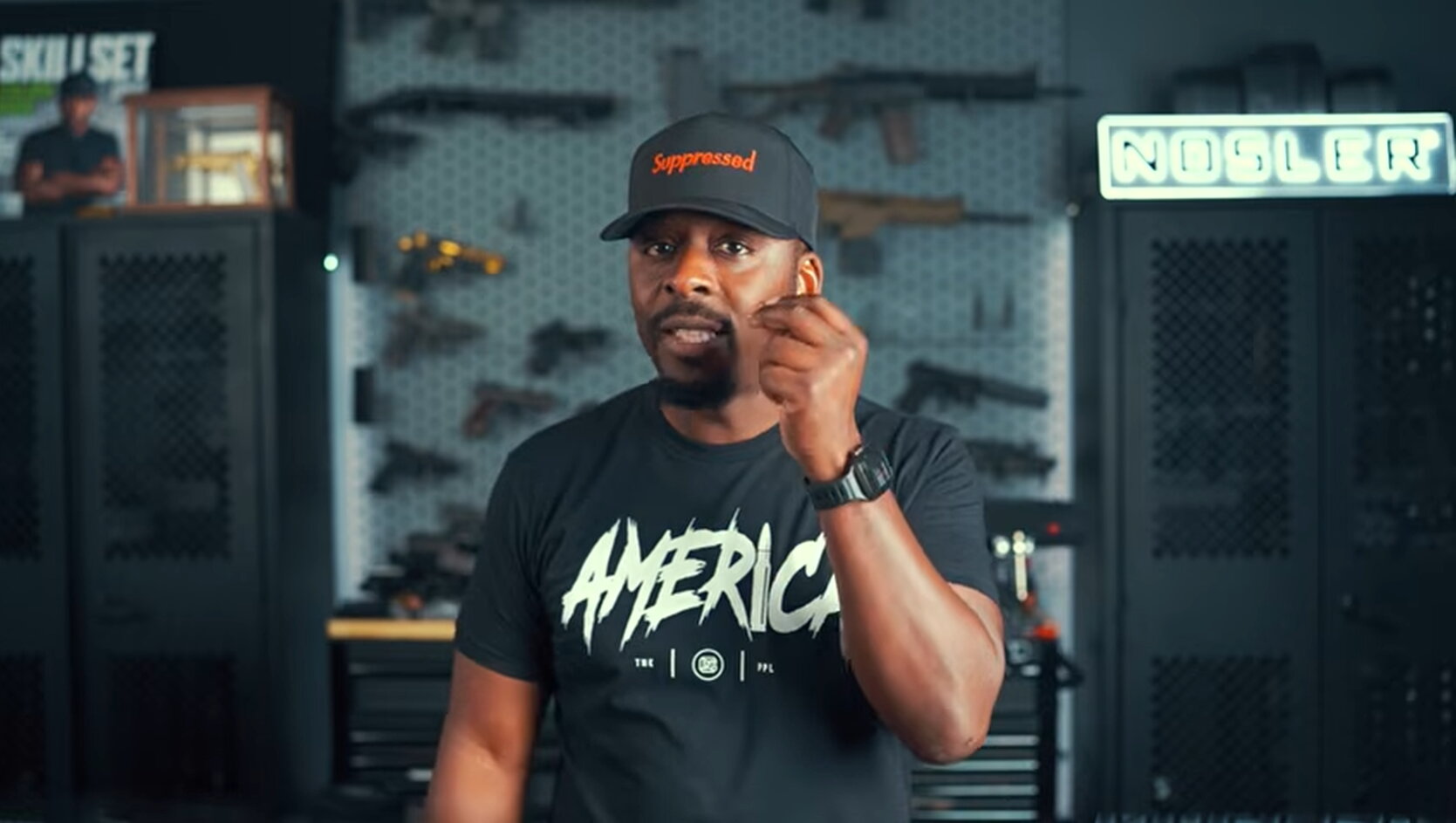
The video's other stated caveat is that a forced reset trigger multiplies muzzle blast along with rounds. Running a dozen shots out of a short barrel in under two seconds, Noir says, is an assault on the shooter's own hearing. That leads into a segment on the AKT1 Blackout in-ear hearing protection, which he says he beta tested for a year and now sells. The product is listed at NRR 25 with foam tips and six-times hearing enhancement, and it is sold through his own storefront. He also promotes a shirt and closes by asking viewers whether a warning shot on an animal is ever anything but wasted ammunition.
The hardware at the center of the argument sits on ground that has shifted twice in two years. A federal judge in the Northern District of Texas ruled in July 2024 that forced reset triggers are not machine guns under federal law, and the Justice Department settled the litigation in May 2025, dropping its appeal and agreeing to return seized devices. More than a dozen states ban the devices anyway, California among them, and a coalition of state attorneys general is challenging the settlement in court.
For context
- Forced reset triggers are federally legal following the July 2024 district court judgment and the May 2025 Justice Department settlement, but more than a dozen states ban them and a multistate challenge to the settlement is still pending.
- The Alaska Department of Fish and Game lists flattened ears, raised hackles and lip licking as signs a person is too close to a moose, and advises putting an obstacle between yourself and a charging animal.
- The agency also notes that more people in Alaska are injured by moose each year than by bears.
- Noir's earlier bear video, which he cites here as the origin of the argument, centered on footage of a charging animal that absorbed a solid hit from a full-powered rifle and kept coming.