Why it matters: Tourniquets are the one piece of trauma gear most armed civilians actually carry, and they do nothing for a wound where the leg meets the pelvis. Dirty Civilian has now put a full demonstration of the alternative on YouTube, including the parts most videos skip.
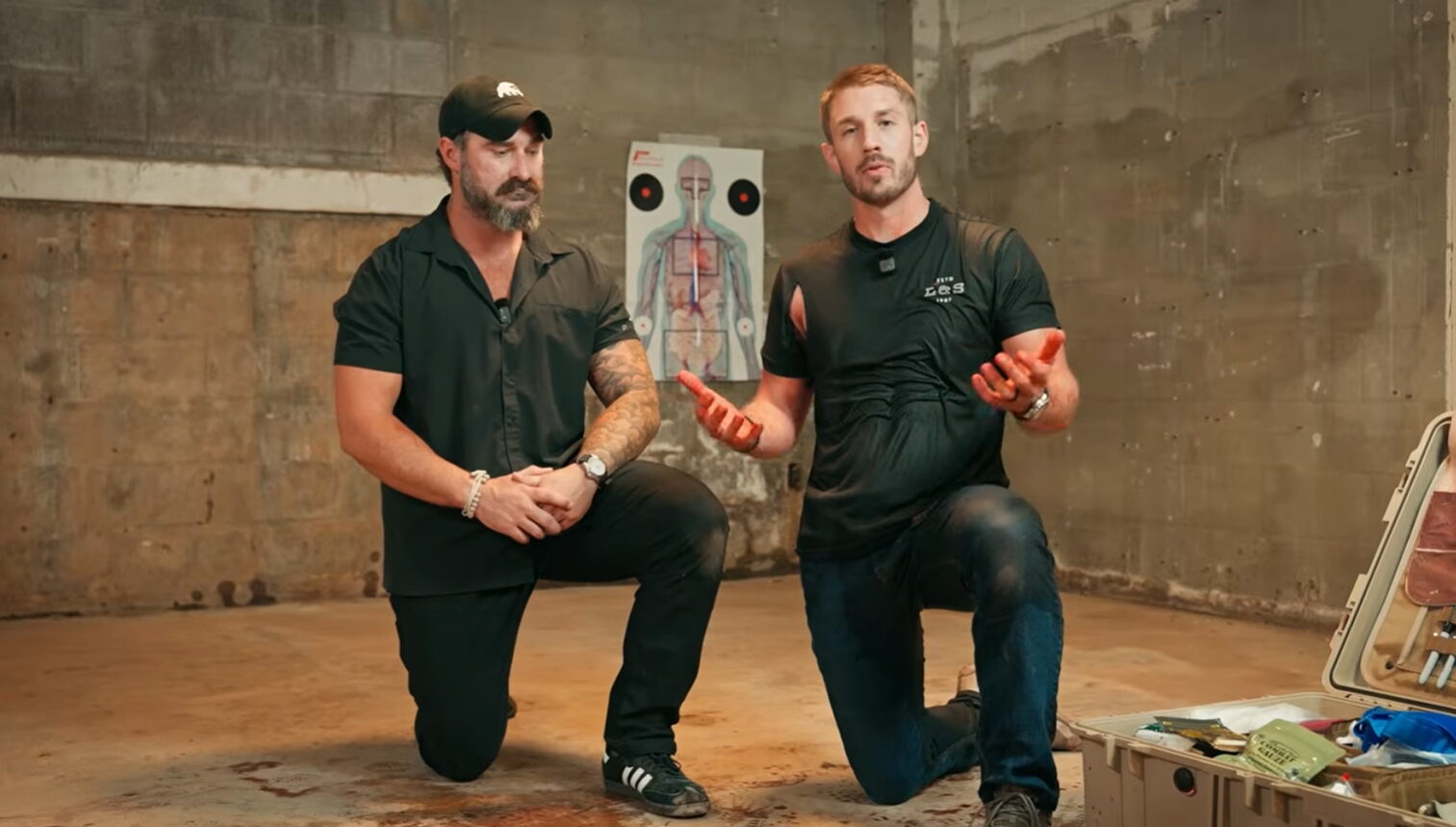
Dirty Civilian has published a demonstration video on controlling bleeding at junctional sites — the neck, the armpit and the groin — where a limb tourniquet cannot be applied. The video is titled "Gunshot Wounds To The Groin, Neck, and Armpit | Junctional Wounds & How to Fix Them," and it pairs the channel's host with Paul, a returning guest instructor who teaches medical courses through BAER Solutions, a Tennessee training company.
The piece opens with a scripted comedy sketch — a mock casualty scene in which a wounded soldier is more worried about his anatomy than his blood loss — before the video shifts to the demonstration and stays there. The host frames the problem in the introduction: civilians often do carry tourniquets, he says, but tourniquets only work on arms and legs.
Paul's framing is geographic. "The key difference here ultimately is location, location, location," he says in the video, defining junctions as places where two parts of the body meet — neck, armpits, groin — and where 360-degree circumferential pressure has nothing to compress against. His stated sequence is identify, expose, then direct pressure through what he calls wound exploration, using a hand, gauze or a piece of clothing. He is explicit about the ceiling on what any of it accomplishes: "We don't fix anybody. We just buy more time."
Wound packing technique, demonstrated on the groin
The groin segment is the longest. Paul exposes a simulated wound, puts a finger into the wound track until he can feel what he describes as a pulsating mass, and presses on the vessel from the heart side — his point being that arteries carry blood away from the heart, so pressure applied distal to the injury accomplishes nothing. He then replaces the finger with hemostatic gauze held in his palm, feeding it in a small handful at a time in what he calls pack and replace, and warns against panic packing, meaning jamming the entire roll in at once.
He deliberately demonstrates the failed version as well, packing the shallow end of the wound rather than the vessel, and shows that adding more gauze on top does not correct it. The finished pack leaves roughly a golf ball of gauze standing proud of the wound so the bandage compresses down into the track rather than sitting flush.
The bandaging is treated as a separate skill. Paul uses a six-inch pressure bandage, starts at the belt line and wraps toward the knee, comes back up under the opposite leg to build intersecting lines, and finishes with a square knot and a long tail. He notes on camera that cutting the pant leg would let the bandage sit closer to the wound and would let a rescuer strip blood-soaked clothing to limit hypothermia, but that it is not required.
Armpit and neck bleeding control on video
For the armpit, Paul works up under the shoulder toward the brachial artery, packs the same way, and then anchors the bandage in a figure-eight over the opposite shoulder rather than wrapping the chest — the goal being pressure concentrated into the wound rather than around the torso. Asked directly whether a tourniquet could simply be placed over the wound, he says no, and cites the two to three finger widths of distance a tourniquet needs between the cuff and the injury.
“The video's real subject is not the gauze — it is the three inches of anatomy a finger has to find before the gauze matters at all.”
Marcus Hale, The ReticleFor the neck, he directs pressure downward, toward the heart, and wraps the bandage around the casualty's opposite arm — tricep or lat — so the wrap is anchored without compressing the airway. He demonstrates conscious and unconscious variants for both sites, and closes by putting the simulated casualty in the recovery position and naming hypothermia as the follow-on risk once bleeding is controlled.
The wounds are moulage. Paul credits Strategic Medical Research and Training, which he describes as an East Tennessee company run by former special operations medics, and a third person, Jason, works a blood bladder off camera to keep the wounds under pressure during the demonstration.
What the video says about hemostatic gauze
Paul compares three packing materials by the compression time their manufacturers claim: roughly three minutes for QuikClot Combat Gauze, roughly 60 seconds for Celox Rapid, and roughly ten minutes for plain gauze. The first two figures match the manufacturers' published literature, and the Committee on Tactical Combat Casualty Care recommends holding direct pressure for at least three minutes after a hemostatic dressing is packed. Paul adds that in practice he does not hold for the full interval — he wraps and moves on to the next problem — and offers a check for failure: if the gauze comes out saturated enough to wring, the pack is not working and needs more material or a restart.
He also addresses the objection that hemostatic agents burn. Early-generation granular products did produce heat, he says; current gauzes work by stimulating the body's clotting factors instead. That tracks the public record. The original QuikClot was a zeolite granulate whose reaction with blood was exothermic and could cause burns; kaolin-based Combat Gauze replaced it in 2008. Celox uses chitosan, a shellfish derivative, which Paul raises on camera to say it is not an anaphylaxis risk.
The video carries sponsor reads for Wetworks, Steele Industries, Rifle Speed and Ammo Squared, and closes with the host directing viewers to Paul's courses. The host's closing argument is that reading about trauma care is not the same as having done it, and that on the numbers, a civilian is more likely to save a life with medical training than with a carry gun. Outtakes run over the end.
For context
- Junctional injuries are wounds at the neck, armpit and groin, where a limb meets the torso and a tourniquet has nothing to compress the artery against.
- The Committee on Tactical Combat Casualty Care recommends at least three minutes of direct pressure after a wound is packed with a hemostatic dressing.
- QuikClot's original zeolite granules reacted with blood exothermically and could burn tissue; kaolin-based Combat Gauze replaced that formulation in 2008.
- Paul teaches open-enrollment, private and law-enforcement medical courses through BAER Solutions, a Tennessee training company.
Sourced from
Gunshot Wounds To The Groin, Neck, and Armpit | Junctional Wounds & How to Fix Them
Watch the original