Why it matters: FAST is one of the newest formats on the two-gun calendar, and it asks competitors for a $300 entry fee and, by one competitor's count, 800 to 1,600 rounds of ammunition. This first-hand account from a rifle-focused creator lays out what its long-stage design demands of shooters and gear, and where one first-time competitor says it falls short.
Brass Facts, a YouTube creator who says they rarely cover matches on the channel, published a video on October 23 titled "A new type of 2 gun action match." It is a stage-by-stage account of FAST Idaho, the Firearms Action Shooting Trials event held October 9 to 11 at the Parma Rod and Gun Club. Brass Facts says the match is "definitely not for everyone" but is "at least worth considering."
FAST Idaho format: six-minute par times and high round counts
Brass Facts describes FAST as inspired by Brutality matches but without their physical fitness tasks. What remains is heavily themed stages, positional shooting, targets at varied distances, high round counts and long continuous courses of fire. Most stages, they say, are built around a six-minute par time, and many competitors use nearly all of it, shooting more or less without a break for five to six minutes. The video argues that this stresses the shooter, the shooter's body and the equipment, especially in the fine Idaho dust the creator calls "moon dust."
The squad started on stage two, which had eight spinner targets: two engaged prone at 100 yards, one each from left and right barricades at roughly 50 to 75 yards, both again with a handgun at 15 yards, then both again with a rifle back at 100. According to Brass Facts, every member of the squad hit the par time with spinners still standing, and several ran out of ammunition. They say the stage alone accounted for 600 seconds of their match total, at an event where top finishers scored roughly 1,400 to 1,800 seconds.
On the next stage, Tainted Soil, a pistol array required about 30 hits but often took around 60 rounds. Brass Facts ran through every pistol magazine they carried and borrowed one from the camera operator. A squadmate running a suppressed Mark 23 did not have enough magazines for that stage; Brass Facts says three people picked spent magazines off the ground, reloaded them and handed them back mid-stage, and that this went on for about three stages. They placed ninth of 36 in division and 24th of 81 overall there.
Spinner targets and par-outs at FAST Idaho
The video's main complaint is the spinner. Brass Facts says FAST Idaho was the first time they had seen or shot one, and that unlike a Texas Star, movers or a plate rack, it cannot be beaten with speed and accuracy alone; it takes technique and experience. The first three stages held 12 spinners, most at about 100 yards. By their account, spinner penalties cost squad members anywhere from 300 to 800 seconds on a match totaling about 2,000. They say a reload mid-spinner lets its momentum bleed out and can cost five to ten seconds or a full restart.
For comparison, Brass Facts says experienced shooters cleared spinners in 10 to 15 seconds, and match director Russell Phagan could flip the hardest one in under five. One or two per match would be fine, they say, but at this volume a shooter who cannot clear one quickly is effectively capped below 20th place, which they call "really lame" for a match that promises varied shooting.
The video is sponsored by Blue Alpha, the belt maker, and includes an ad read noting that seven of the 11 shooters on the squad wore its belts.
Long-range wind, gear and spotters on the late stages
“In Brass Facts' telling, one target type moved the standings more than any distance, position or wind call did.”
Marcus Hale, The ReticleBrass Facts reports their best results on the tower stages: fifth of 37 in division on one and fourth of 37 on the next, where they say they pushed past their speed limit and forgot to drink water. They say they arrived skeptical of the handgun requirement but came around to it, though carrying enough pistol magazines meant changing their gear.
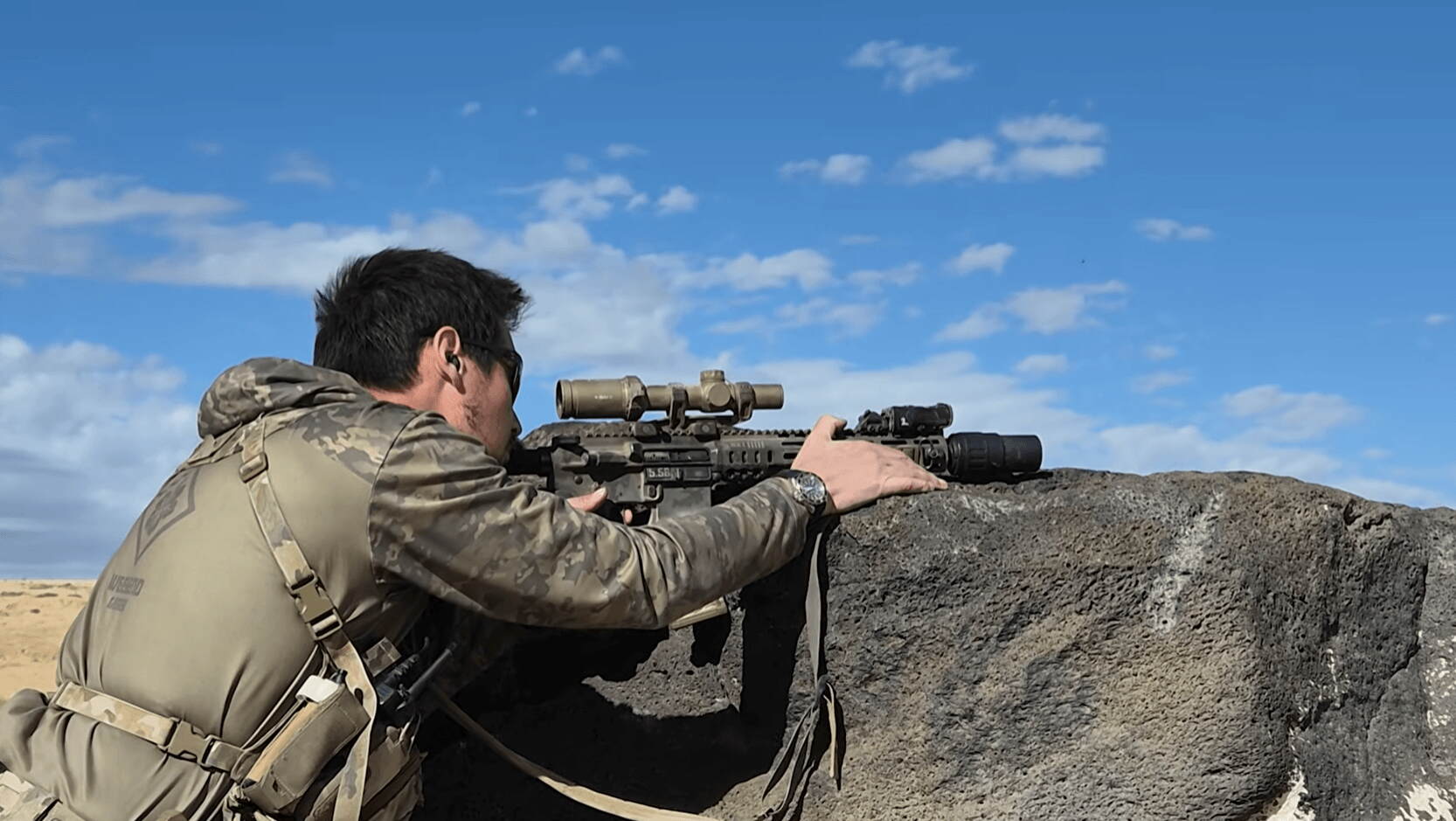
On stage six, long-range targets ran from 200 to just under 400 yards in wind the creator estimates at around 10 miles an hour. They shot it from an 11.5-inch carbine with a 6x optic and no bipod, despite being told that a bipod and an SPR-style setup were close to necessary, and finished 18th in division. On the vehicle stage, they say their point of impact shifted mid-stage; they suspect a pivot-mounted light was pressing on the suppressor, and pushing it clear fixed the problem.
Reheat, a four-minute stage, subtracted 5 to 25 seconds per hit on reduced-size targets from 200 to 700 yards. Brass Facts says they shot first, before a dedicated spotter with a high-magnification scope had set up for the far targets, so they skipped corrections and worked the 200- and 300-yard targets fast, placing 11th in division. Shooters who repeatedly hit the 700-yard target went negative on time, a gap the creator puts at almost 300 seconds. The final stage required unsupported rifle shooting, which Brass Facts says was the first of the match and which they would like to see more of. They finished 28th overall and 12th in division.
Entry fee, round count and stage design: Brass Facts' verdict
Brass Facts calls the $300 entry fee the highest they have paid and puts the minimum round count at about 800, with most shooters doubling it, before travel and lodging. Given that cost, they say designing stages so most people par out is "a very, very fine line"; timing out over a malfunction or a bad run is acceptable, but "a good shooter should be able to complete the match."
The same design is also what they rate most highly: six minutes of positional shooting on small, distant targets that they say is "not done anywhere else." They credit the match for avoiding photo-op gimmicks, for themed stages that flowed despite long briefs, and for a match director who shoots competitively. They call the community "second to none" and say the match changed their opinion on several aspects of competition.
For context
- FAST, the Firearms Action Shooting Trials, is a match series founded by Russell Phagan, a vice president at KE Arms who also helped organize InRangeTV's Brutality matches.
- Brutality matches, which InRangeTV began with Desert Brutality in 2018, pair rifle and pistol stages with physical tasks such as carries, crawls and climbs.
- FAST Idaho ran October 9 to 11, 2026, at the Parma Rod and Gun Club in Parma, Idaho, and was the first FAST event with an Auto-Rifle division.
- A spinner is a steel target on a pivot that counts only once hits rotate it fully over, so a shooter has to land shots before its momentum fades.