Why it matters: The legal friction that made pistol suppressors easy to dismiss is largely gone, and buyers are being asked to weigh the mechanical case on its own for the first time since 1934.
The creator known as Hop has told his audience more than once that a pistol suppressor was a waste of a tax stamp. In a 22-minute video posted Aug. 25, he says the tax stamp is no longer the part of the argument that matters.
The video, titled "Are pistol suppressors a waste of money?", is built as a three-part complaint — that suppressed handguns shoot poorly, that they hurt reliability, and that they are hard to carry and deploy — followed by the gear Hop says now addresses each one. By the end he moves handgun cans from what he calls an extremely distant fifth place on his list of things to suppress to, in his words, a normal fifth place.
What the NFA changes did to the argument
Hop opens by saying his old objection has worn thin: the federal transfer tax on a suppressor went from 200 dollars to zero, and then the registration requirement appeared to vanish entirely in the past week. He does not walk through the legal detail, and the video is not about the ruling. It uses the change as the reason to reopen a category he had written off. That leaves the mechanical objections standing on their own, and in the video those were never really about the stamp, but about what a tilting-barrel pistol does when you hang extra mass off the muzzle.
Why the video says suppressed pistols shoot badly
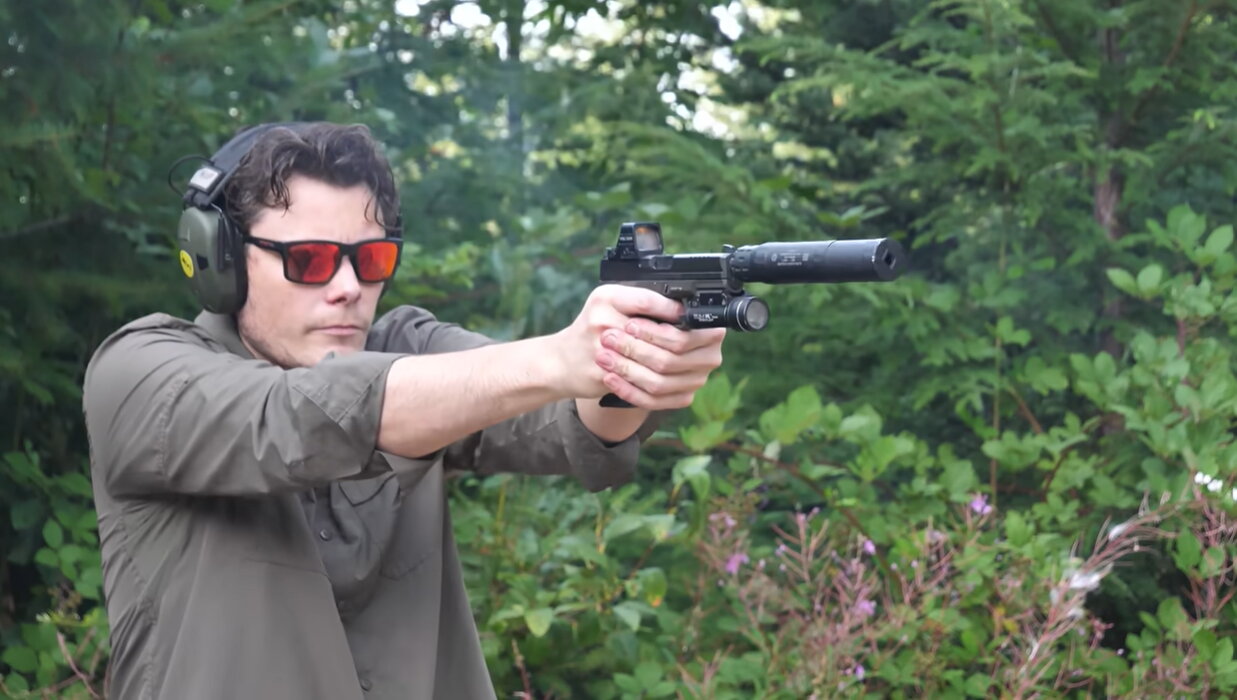
The technical case starts from the fact that nearly every modern service pistol is a Browning-pattern short-recoil design: the barrel has to travel backward and tilt to unlock the action and present the feed ramp. Hanging a suppressor off the muzzle, Hop says, drags the barrel out of the position it needs and drains energy from a system that was tuned without that mass. The usual fix is a booster, a spring-loaded mount that gives the recoil system extra impulse and briefly decouples the suppressor's weight from the barrel and slide. The trade, in his description, is a delayed secondary kick that makes a boosted pistol shoot unlike anything else.
His second complaint is gas. Pistol actions open sooner and sit more open than a rifle's, and pistol ammunition, he says, leaves more unburnt powder behind, so the shooter takes particulate in the face on nearly every round. He singles out the Beretta 92, whose slide is cut open across the top, as one of the least pleasant hosts — a direct challenge to the common claim that the 92 suppresses well.
Springs, subsonics and picky feeding
On reliability, the argument is that a factory pistol is sprung for the ammunition range it was designed around and a suppressor moves the gun outside it. Hop points to suppressor-ready models that ship a heavier recoil spring in the box, naming the Walther PDP Pro SD and the threaded-barrel Ruger RXM, and puts the stock spring on a mid-size Glock-pattern gun at 16 pounds against an 18-pound heavy option. Added back pressure can also run the action faster than the magazine can feed, he says.
Ammunition gets pickier too, in a way he says it does not on the same pistol unsuppressed. The quiet that draws people to the idea requires subsonic loads, which in 9 mm means 147 grains or heavier. Hop reports feeding trouble with flat-nose 147-grain FMJ in both the RXM and a Glock 43, better results from hotter loadings such as Speer Lawman, and no trouble from round-nose 147s. He notes that .45 ACP is subsonic out of the box, which he offers as one reason the HK Mark 23 holds its reputation among suppressor users.
Boosterless titanium cans change the math
“The mechanical objections were never really about the stamp, but about what a tilting-barrel pistol does when you hang extra mass off the muzzle.”
J.D. Whitfield, The ReticleThe gear half of the video argues that full-length boosted pistol cans are the problem, not pistol cans as such. Hop's example is the FOR Systems Pluto 9, a titanium suppressor he says weighs under three ounces and direct-threads onto both his Glock 43 and the RXM with no booster at all, and which he reports running more reliably than his boosted setup across the ammunition he has tried. He rates its suppression close to the Gemtech Lunar 9 in that can's short configuration, pointing out that the Lunar's booster section adds length without adding baffles. He names the Stealth Additive Works Shiv and the Wolfpack Whisper Pickle as products working the same idea. Reduced back-pressure designs help the gas problem, he says, but do not solve it.
The holster problem, still open
Carry is where the video concedes the most. Hop runs the options: the Phlster Floodlight, which FOR says has enough opening at the bottom to take a Pluto-equipped pistol on many platforms; the T-Rex Arms Ragnarok SD and a similar QVO design, both of which index on a weapon light and carry the suppressor's weight; the Crye Precision Gun Clip, which snaps around the trigger guard and is therefore indifferent to whatever is on the muzzle, at the cost of an awkward draw and a hot suppressor resting against the leg; and the Hush Holster, a light-indexed design with a thumb break and standoff from the body. Hop discloses that the Hush Holster's maker is a friend of his.
His remaining objection is a design one: most semi-automatic pistols were never meant to be suppressed. He points at the SilencerCo Maxim 9, both the integrally suppressed version and the roller-delayed one, as the shape of a better answer, and says he would like to see manufacturers build more fixed-barrel or delayed-blowback handguns intended to wear a can full time.
Where he lands is that a handgun suppressor is still fifth on his list, behind a fighting rifle, a universal .30-caliber can, a subgun can and a rimfire can. What changed, he says, is that it is now a normal fifth rather than a distant one.
The video carries a read ad for Blue Alpha, which Hop identifies as the channel's sponsor. Blue Alpha makes belts and is not connected to any of the suppressors or holsters discussed.
For context
- The One Big Beautiful Bill Act, signed July 4, 2025, cut the 200-dollar federal transfer and making tax on suppressors, short-barreled rifles, short-barreled shotguns and AOWs to zero effective Jan. 1, 2026.
- On Aug. 5, 2026, Judge James Wesley Hendrix of the Northern District of Texas ruled in Silencer Shop Foundation v. ATF, consolidated with Jensen v. ATF, that the NFA registration scheme could not be enforced on those items once the tax reached zero; the injunction took effect at 12:01 a.m. Central on Aug. 13, and the government retains a right to appeal to the Fifth Circuit.
- A booster, also called a Nielsen device, is a spring-loaded suppressor mount that lets a short-recoil pistol cycle with a suppressor's mass on the muzzle. Rifles with fixed barrels do not need one.
- Subsonic 9 mm generally means bullets of 147 grains or heavier, while .45 ACP is subsonic in most factory loadings, which is why it has long been favored for suppressor use.