Why it matters: Photographs of this rifle have circulated among collectors for years with an attribution nobody can source. The video is the first look at the parts of it those photographs never showed.
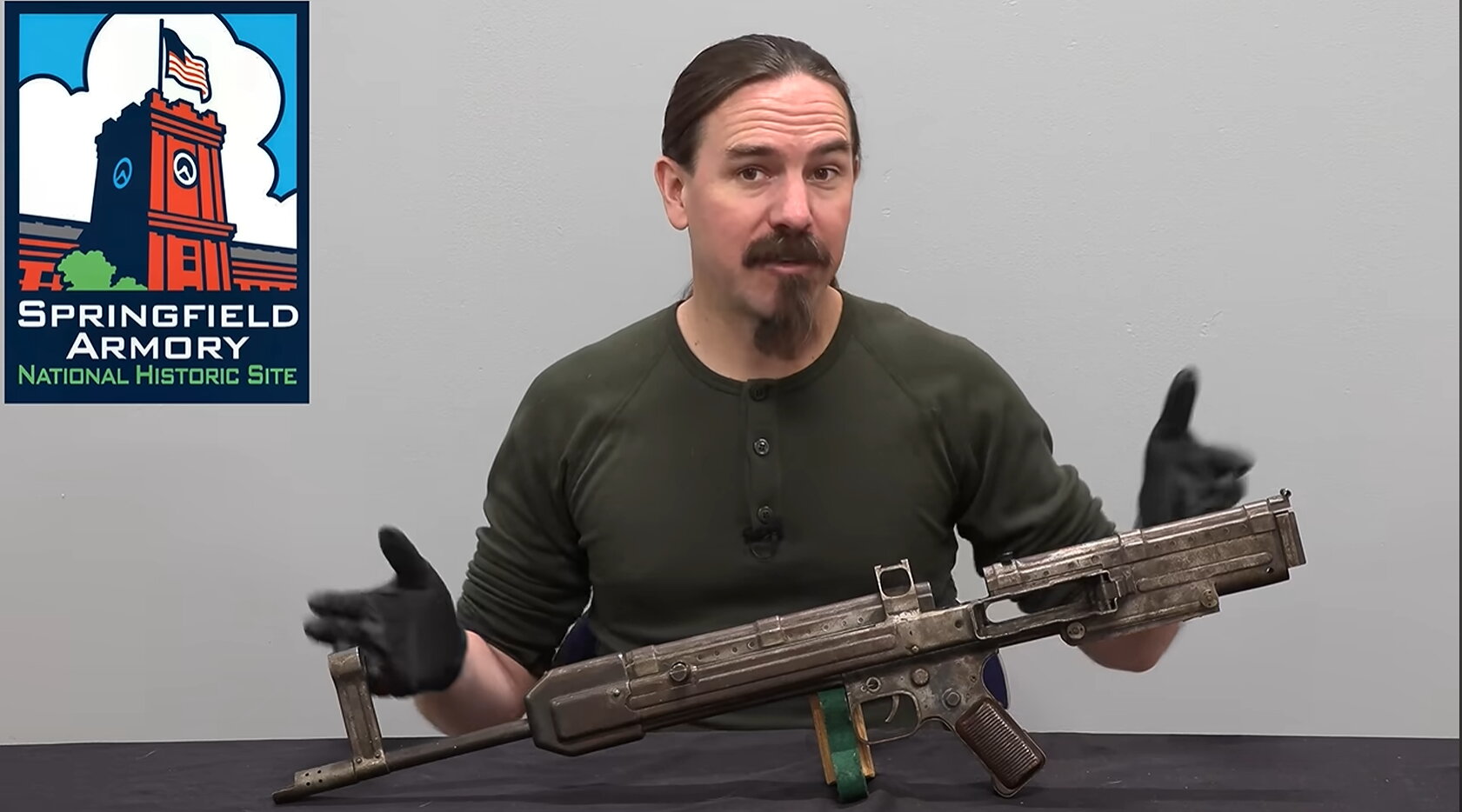
Forgotten Weapons published a video on August 24 examining an unidentified German rifle held in the reference collection of Springfield Armory National Historic Site, the museum on the grounds of the former US armory that operated until its closure in the late 1960s. Host Ian McCollum films the gun as a documentation exercise rather than an identification: the piece is catalogued as a Knorr-Bremse product and is widely described online as an FG 42 prototype, and the video states that neither claim can currently be sourced.
The museum's accession record for the rifle is not documented, according to McCollum, so where and when it entered the collection is unknown. He says the gun's characteristics place it in late-war Germany but that the route it took to Massachusetts — a captured factory, the 1945 seizure of Mauser's research materiel, or something else — is not established. He also reports finding no markings of any kind on the gun, including the wartime manufacturer code he associates with Knorr-Bremse.
What the Springfield Armory rifle shows
The video's stated purpose is to record detail absent from the profile photographs that circulate online. Working front to back, it shows a muzzle device with two rows of holes around its circumference and a scoop at the front; a tall front sight post with a non-adjustable blade formed as one welded assembly; and a front end cap retained by a pin, carrying a sling bar. With the cap removed, the video shows a gas block and what McCollum describes as a probable short-stroke piston.
The receiver is a stamped upper spot-welded to a lower section, which McCollum characterizes as sophisticated stamping work. A milled block welded to that stamped receiver carries the rear sight. The charging handle sits on the left side and carries a latch that engages a notch in its track, which the video reads as a non-reciprocating design that locks forward during firing. The magazine well is side-mounted and sized for 7.92x57mm Mauser rather than the shorter 7.92x33mm Kurz cartridge.
The detail McCollum flags as the most significant is at the top of the barrel extension: two vertical drilled holes, which he says suggest a roller-locked action along the lines of the MG 42. The rollers themselves are not present.
What is missing from the gun
“The rifle answers to the FG 42 specification in almost every visible way, and to none of its paperwork.”
Tess Marlowe, The ReticleThe rifle is substantially incomplete. The video identifies the bolt and carrier, a top cover element, a bottom cover, and any buttstock as absent, with the rear of the receiver slotted for a stock that is no longer there. McCollum notes the trigger and a cross pin in the grip assembly are seized and says he declined to force either. The stamped pistol grip has internal reinforcements and wooden grip panels, which he describes as a technique used on FG 42 fire control grips. The hammer is visible inside the action in the fired position and appears to him to be dimpled, which he takes as an indication it was not hardened and that the gun is not a finished product.
Why the FG 42 attribution is unsettled
The FG 42 program ran on the LC-6 specification issued in December 1941, which capped overall length at 1,000 mm, held weight to roughly that of the Karabiner 98k, and required the full-power 7.92x57mm cartridge. Six firms were solicited: Gustloff-Werke, Mauser, Johannes Großfuß, C.G. Haenel, Rheinmetall-Borsig and Heinrich Krieghoff. Rheinmetall-Borsig's design was adopted as the FG 42 in 1942.
Knorr-Bremse was not among them, which is the core of the problem the video lays out. McCollum's argument is that the rifle answers the specification closely — overall length, side feed, cartridge, grip construction — while the company credited with building it had no role in the competition, and that there is no unaccounted-for FG 42 submission, because the guns from both firms that actually submitted are known and documented. He offers a late-war attempt at an FG 42 replacement as one possibility, notes that the quality of the stamping would fit a later date better than an early-war one, and declines to reach a conclusion.
McCollum credits the museum for access to the reference collection and directs viewers to its public displays of US military small arms and prototypes.
For context
- The LC-6 specification of December 1941 required a Luftwaffe paratroop rifle no longer than 1,000 mm, no significantly heavier than a Kar98k, and chambered in 7.92x57mm Mauser.
- Rheinmetall-Borsig won the competition and its design entered service as the Fallschirmjägergewehr 42; Krieghoff later manufactured the type.
- Knorr-Bremse, a brake manufacturer, put one small arm into production: the MG 35/36 light machine gun, built on a licensed Swedish design and fielded in small numbers.
- The so-called Mauser train, a 1945 Allied capture of Mauser research materiel and prototypes, is one documented path by which late-war German experimental guns reached US collections.