Why it matters: The Kuna arrived under a coordinated embargo that put dozens of near-identical first-look videos on YouTube the same day. A review that lands more than a year later, on a gun the reviewer says he would never have bought, is one of the few chances buyers get to hear about the platform outside the launch-day chorus.
A new Administrative Results video reviews the Springfield Armory Kuna and reaches a deliberately neutral verdict, with the host saying repeatedly that he is "very whelmed" by the 9mm pistol. The video is titled "The Kuna Has Whelmed Me."
The Kuna is imported by Springfield Armory and built by HS Produkt in Croatia, the same manufacturer behind Springfield's Hellcat line. It is a roller-delayed blowback 9mm large-format pistol with a 6-inch cold hammer forged barrel and a monolithic aluminum upper, listed at $999 MSRP, or $1,149 with the folding brace. The host says the Croatian design was intended to give that country's forces a more modern 9mm platform to replace aging MP5s.
The video reports roughly 500 rounds fired with zero malfunctions to that point. The host frames the round count as a warm-up rather than an endurance test and says he is not attempting a deep technical breakdown, in part because the platform was covered heavily at launch.
Nexus Firearms lower replaces the Kuna magazines
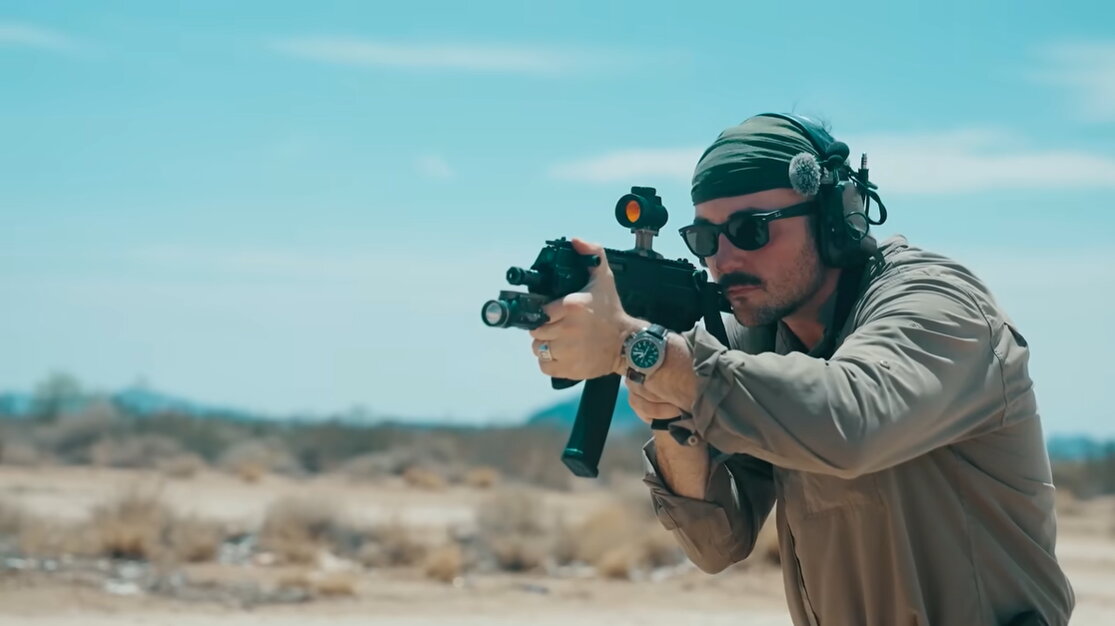
The gun in the video is not stock. The host says the sample was supplied by Nexus Firearms, which wanted its aftermarket Kuna lower receiver shown, and that without it he likely would not have sought out a Kuna of his own. The Nexus lower accepts CZ Scorpion pattern magazines, including Magpul's, and standard AR-15 fire control groups; the unit in the video is fitted with a forced reset trigger and its trip bar. Nexus lists the lower at $349 for the paddle-release version and $374 for the push-button version.
The host says the factory Kuna's proprietary magazines "have been shown to not be as reliable," and that "a lot of people were having issues where the magazines were just breaking." Springfield's factory magazines are 30-round proprietary units that do not interchange with Glock, CZ Scorpion, or MP5 patterns. Reports of feed-lip cracking in early production circulated through the platform's first year, and later production magazines carry a revised follower and a stiffer spring. He credits the Nexus lower with raising the gun's appeal by moving it onto cheap, widely available magazines.
Three complaints: sights, recoil impulse, bolt catch
The host lists three objections. The first is the flip-up backup sights, which he says are placed awkwardly because the handguard slopes away from the barrel, leaving little room forward; he says he likes having integral irons on principle but does not expect to use these. The second is the recoil impulse under the forced reset trigger, which he describes as an unusual pattern he attributes in part to the Kuna being lighter than comparable guns. He says he shot tighter groups with 5.56 at the same distance and rated a Zenith ZF5 with the same style of trigger as the better performer, while noting the gun "works really fine in semi-automatic." The third is the bolt catch, which he says he made harder to reach by mounting an angled foregrip in front of it.
On the positive side he cites the non-reciprocating charging handle, which he found comfortable as a thumb rest, the built-in sights, and the price. He estimates the Kuna at roughly a third the cost of an H&K SP5, which he calls the platform's main draw for buyers.
“A gun that survives a review by a host who did not want it, and would not have bought it, has told you something a launch-day video cannot.”
J.D. Whitfield, The ReticleHe also flags the handguard as a limitation, describing the rail space as "anemic" — two M-LOK slots per side plus a slot and a half on the bottom — and says he would like to see Springfield offer a longer barrel or a suppressor-focused variant in the mold of the MP5SD. His own configuration, which pairs a Trijicon MRO on a Reptilia mount with a scavenged Picatinny section and an angled foregrip, is one he says will probably be dismantled.
Embargo saturation and the wider PCC market
The video opens with commentary on how the Kuna was launched. The host describes Springfield Armory as "a very media embargo heavy company," explaining that creators sign an NDA and post on a common release date, and says his objection is to the resulting same-day saturation rather than to the practice itself. He calls it "maybe some kind of like outdated media tactic," says he does not work with Springfield and has never been approached by them, and adds that he prefers subjects without embargo dates.
He closes on the market rather than the gun. Pistol caliber carbines were long a luxury buy, he argues, because the money bought less capability than an intermediate cartridge rifle. He credits the elimination of the $200 NFA transfer tax and the availability of forced reset triggers with changing that math. The tax change took effect January 1, 2026, under the One Big Beautiful Bill Act, and removed the $200 stamp for suppressors, short-barreled rifles and shotguns, and any other weapons, while leaving registration and ATF approval in place. Forced reset triggers are legal federally following the Fifth Circuit's 2024 ruling and the subsequent settlement, and remain prohibited in roughly fifteen states and the District of Columbia.
His conclusion is that the Kuna is a reasonable option at its price and not a gun for him. "I don't think I would be a good target demographic unless they do some more cool stuff with the platform," he says. The video discloses sponsorships from Americana Pipe Dream Apparel, OpticsPlanet, Sonoran Desert Institute, and Badlands Munitions.
For context
- The Kuna is built by HS Produkt in Croatia and imported by Springfield Armory; it uses a roller-delayed blowback action, the same operating principle as the H&K MP5.
- Factory Kuna magazines are proprietary 30-round units that do not fit Glock, CZ Scorpion, or MP5 magazine wells, which is why aftermarket lowers exist.
- The $200 NFA transfer tax for suppressors and short-barreled rifles ended January 1, 2026; registration and ATF approval requirements did not change.
- Forced reset triggers are federally legal after the 2024 Fifth Circuit ruling and the following settlement, but remain banned in about fifteen states and the District of Columbia.