Why it matters: A national government froze legal firearm purchases without passing a law, and one of American gun media's largest voices is using that speed to make an argument about what purchase permits are worth when the political mood turns.
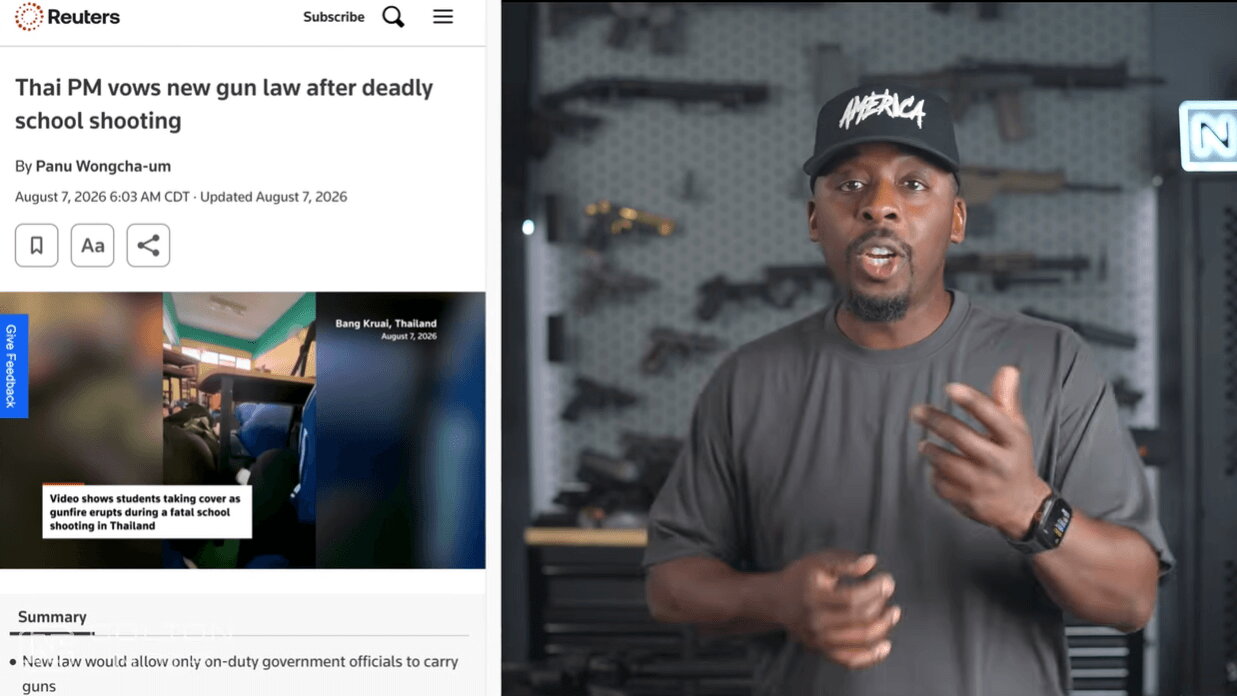
Colion Noir's video, “Thailand's Gun Crackdown Should Be A Warning To Americans,” pairs a broadcast news report on Thailand's response to two August shootings with commentary arguing that the speed of that response is itself the story. The embedded report describes Prime Minister Anutin Charnvirakul's order suspending new permits to purchase firearms and directing a review of existing licenses. Noir's argument turns on one figure in that report: the distance between the firearms Thailand is estimated to have and the firearms it has on the books.
What Thailand's gun permit suspension covers
The report says Anutin announced the suspension on August 11, instructed police to stop renewing permits that allow people to buy firearms, and directed a deputy prime minister to accelerate work on a new gun control law carrying tighter controls and significantly tougher penalties for firearms offenses. It also restates existing Thai law as the prime minister described it: legally registered firearms are to be kept at home and cannot be carried in public without the required authorization.
Wire reporting published the same week adds measures the video does not cover. Anutin's order suspended new “welfare gun” programs, which let civil servants, police, soldiers, local officials and lawmakers buy firearms at government-subsidized prices, and called for a re-review of purchase permits still pending approval along with checks of dealers' records. The Interior Ministry was directed to propose amendments to Thailand's firearms law within 60 days.
The two shootings behind the Thai order
The order followed an August 7 attack at Debsirin Nonthaburi School in Bang Kruai, outside Bangkok. Police said a 14-year-old student killed his grandparents at their home, traveled to the school with a handgun belonging to his grandfather, opened fire there and then killed himself. Nine people died in total, including the grandparents and the gunman, and more than 20 were injured. It was Thailand's deadliest mass killing since the 2022 Nong Bua Lamphu daycare attack. Three days later, police arrested a former lawmaker after a shooting at a provincial government office in the same province that killed a local official; investigators attributed that shooting to a dispute over borrowed money.
The registration gap at the center of the argument
The embedded report puts roughly 10.3 million firearms in Thai civilian hands — the highest estimated civilian ownership rate in Southeast Asia, about 15 guns per 100 residents — against roughly 6 million registered, leaving more than 4 million unregistered or otherwise unaccounted for. Those numbers trace to Small Arms Survey estimates published in 2017. The Geneva-based group presents them as modeled figures built from government data, survey work and expert assessment rather than a counted inventory, and unregistered firearms are by definition the category hardest to measure.
“The dispute is not whether Thailand moved quickly. It is what a purchase permit is worth once a government decides to stop issuing them.”
Coleman Reyes, The ReticleThat gap is the spine of Noir's commentary. Of the roughly 4 million untracked firearms, he says, “the response to that is to close the front counter.” He argues the suspension leaves a person in Thailand who does not already own a gun unable to buy one, in the same week the government has been telling the public the country is dangerous. He does not argue the policy fails on arithmetic alone; his claim is that it acts on the registered side of the ledger and leaves the unregistered side where it was.
Permit to purchase, in Thailand and in the states
From there the video moves to vocabulary. Permits to purchase and permit renewals are, in Noir's phrasing, “the vocabulary of permission,” and anything that requires approval can stop being approved — which, he says, is exactly what happened. He extends the point to the United States, saying several states are “running a smaller version of the same play” with permit-to-purchase requirements, which he characterizes as converting a right into a privilege and, in his view, violating the Second Amendment. The difference he draws is procedural rather than philosophical: in Thailand the change arrived by announcement, while in the United States, he says, such measures have to be fought in court.
The video also carries a merchandise read for an “America 2A” hat and shirt design, which Noir ties directly to the argument he is making, and closes with the channel's standard request that viewers like, comment, subscribe and share against what he describes as suppression of gun content by platforms.
Thailand's next move is legislative. The Interior Ministry's 60-day window would put proposed amendments in front of the government in October. Whether the eventual law reaches the unregistered stock — through amnesty, registration drives, enforcement, or not at all — is the question the video leaves open, and the one Thai reporting has been working since the announcement. Traders in Bangkok's firearms district told Reuters the following week that they believed the crackdown missed its target.
For context
- Thai law requires a government-issued permit to purchase a firearm and separate authorization to carry one in public, a structure that predates the current order.
- The August 7 school attack was Thailand's deadliest mass killing since the October 2022 Nong Bua Lamphu daycare attack.
- “Welfare gun” programs let eligible public officials buy firearms at subsidized prices; new ones were suspended as part of the same order.
- Small Arms Survey figures for Thailand date to 2017 and are estimates, not a government inventory.