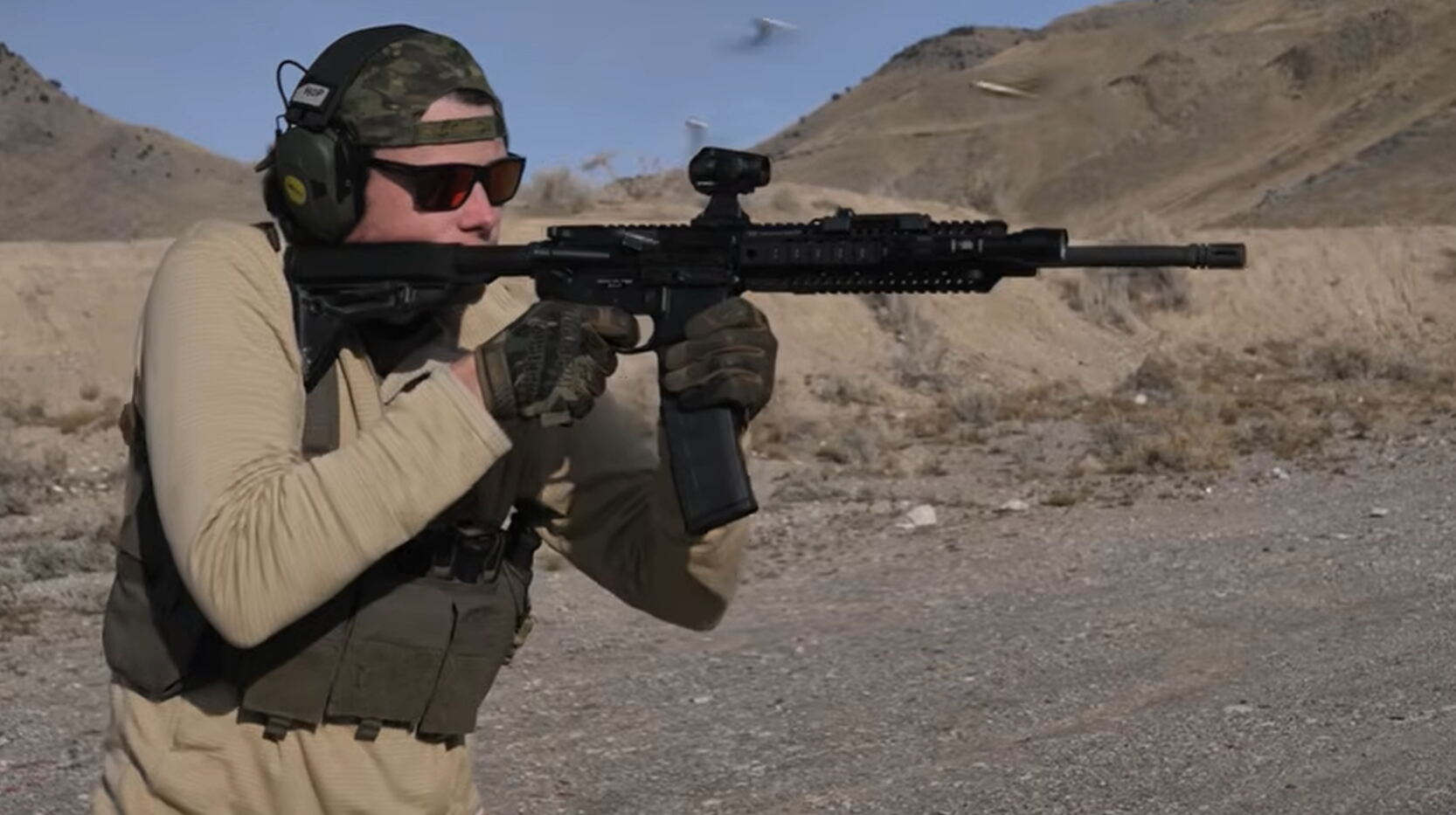
Why it matters: Forced reset triggers have put sustained-fire behavior in the hands of buyers who have never had to think about barrel temperature. This video is one of the few public attempts to attach round counts to that problem across every category on the market.
Brass Facts has published a survey video, "IAR vs SAR vs LMG," that divides the AR-pattern support weapon field into four tiers and reports the round counts at which examples of each cooked off under cyclic fire. The host frames it as groundwork, saying the question of when any of these guns is the right choice is held for a follow-up.
Much of the range footage was shot at the Red Right Hand range in Idaho, and the host discloses at the outset that a large share of the hardware on camera comes from that company's catalog. He states that he received no free product and no compensation, that he paid for range access with a dinner, and that viewers should account for bias regardless. The video also carries a sponsor read for Venture Surplus, which he says funded the ammunition.
What the cook-off burndown tests showed
The measurable core of the video is a pair of cyclic burndown tests. An IAR belonging to a second shooter, described as a basic heavy-barrel design and, in the host's framing, comparable to the military M27 from a thermal mass standpoint, cooked off after 240 rounds, with the round igniting roughly 15 to 20 seconds after the gun went quiet. A Red Right Hand IAR fitted with that company's machined heat sinks did not cook off at 240. At the 300-round mark it did, but the host says ignition took well over a minute to arrive.
His reading of the gap is deliberately narrow. Heat sinks, he says, do not meaningfully increase the gun's total thermal mass; they add surface area and draw heat away from the barrel, which delays the event rather than preventing it. He adds that pouring water over the fins reportedly works well, and that because heat sink designs keep appearing in military contract submissions with demanding rate-of-fire requirements, he suspects the benefit at realistic firing schedules is larger than one extra magazine — while stating plainly that he has not measured it.
Cook-off is the failure mode the whole video is organized around. The host puts the relevant internal temperature at roughly 400 to 500 degrees Fahrenheit, enough for a chambered round to ignite without a trigger press, and presents it first as a safety problem in team settings where people may be forward of the shooter. He ties it to accounts of M4s and Mk 18s cooking off during break-contact fire in the Global War on Terror, and to the SOCOM-profile heavy barrel adopted afterward. He relays a caveat credited to another commentator: temperature-sensitive propellant common in that period may have been the larger factor.
Where the four support weapon tiers separate
The baseline tier is a standard carbine running an FRT, which the host treats as a non-contender in a support role. Past roughly 150 yards, he says, it is harder to control than semi-automatic fire from the same rifle and produces similar suppression for far more ammunition, while the direct-impingement gas tube becomes a genuine failure point at sustained cyclic rates. He describes FRT use in a carbine as a break-glass option rather than something the gun is built around.
The second tier is the basic IAR, which he characterizes as a heavy-barrel HK416. He cites 75 rounds per minute sustained as a contract stretch goal and says the minimum he could find tracks a SOCOM-barrel M4 at about 36 rounds per minute, reading both as evidence the M27 was never intended as a machine gun replacement. In civilian configurations, he argues most of the perceived improvement comes from the bipod and the longer gas system rather than the IAR designation, and that a heavy-barrel general-purpose rifle or an SPR-style build with a bipod covers much of the same ground.
“Every tier in the video is organized around one variable: how long the gun fires before it lights a round off by itself.”
Avery Lindqvist, The ReticleThe third tier, which he calls an IAR-plus or squad auto rifle, is where he says the additions start to matter: longer and heavier barrels for thermal mass and recoil absorption, mid- or rifle-length gas systems for dwell time, granularly adjustable gas to bring cyclic rate down from a common 1,000-plus rounds per minute toward roughly 850, a one-piece machined or Inconel gas tube or a piston conversion to retire the gas tube failure, a heat sink, and optionally a suppressor, which he notes improves controllability while adding heat back into the system. Properly stabilized, he says such a gun will place four of five rounds of a burst on target at 200 yards and beyond.
What belt-fed uppers buy, and what they cost
The top tier is the belt-fed upper: the host names the FightLite MCR, the Cloak Industries MFR and the Lima 6. His summary is that ammunition on tap is the actual product. Magazine-fed guns top out near 60 rounds using drums and casket magazines that he calls only somewhat reliable and unfixable in the field when they break. Shootability, he says, is roughly comparable to a medium-tuned squad auto rifle, with more per-shot movement in a magnified optic but more consistent and more circular dispersion on bursts past about five rounds.
The costs are substantial. The uppers feed from M27 links rather than AR magazines, malfunction at a higher rate, and require tuning that he says has occupied him for two years. They also depend on an FRT to make sense at all, and he describes FRTs themselves as unreliable hardware. On heat, he reports belt-feds cooking off just past the 300-round mark in cyclic testing, comparable to a medium IAR, and argues that because the platform carries far more ammunition the practical cook-off may arrive sooner. He expects a quick-change barrel to be effectively mandatory for a genuine support-by-fire role — the MCR and MFR offer one, the Lima 6 does not — and flags the sustained-fire figures as work he still intends to do.
His closing summary returns to the carbine. In his own testing, he says, a 240-round break-contact drill spread over about seven minutes, fired faster than typical cadence, did not reach cook-off on a modern medium-profile barrel. He describes belt-feds as expensive, niche and, in his word, irresponsible, while allowing they check boxes nothing else does.
For context
- A forced reset trigger resets the trigger mechanically to allow faster semi-automatic fire; the Justice Department settled its litigation over the devices in May 2025, though a number of states still ban them under their own rapid-fire statutes.
- Cook-off is the unintended ignition of a chambered round by heat conducted from a hot barrel and chamber, with no trigger press involved.
- The Marine Corps M27 Infantry Automatic Rifle, an HK416 derivative, replaced the belt-fed M249 in many rifle squads; it has no quick-change barrel and a lower sustained rate of fire than the gun it replaced.
- Red Right Hand LLC is an Idaho maker of AR-pattern automatic rifle and belt-fed uppers built around machined aluminum heat sinks; its range and products appear throughout the video.