Why it matters: The HK416 is one of the few rifles whose public reputation rests as much on a single night in 2011 as on its engineering. This video retells both halves of that story for a general audience, and it is candid about where the documented record stops.
Lujan, a YouTube creator, has published a 14-minute history of the Heckler & Koch HK416, posted September 27 under the title "The Gun That Killed Osama (Operation Neptune Spear & The HK-416." The video follows the rifle from its development as a piston-driven alternative to the M4 carbine to its association with the 2011 raid that killed Osama bin Laden, with short range segments filmed between chapters. The video is sponsored by the Sonoran Desert Institute, an accredited online college that offers firearms technology programs.
Why Delta Force wanted a better M4
The host frames the problem as a mismatch rather than a failure. In the video's account, the M4 was "a very good rifle," but special operations units were running shorter barrels, suppressors, full-automatic fire and high round counts that pushed it past the conditions it was designed for. The host attributes that framing to Larry Vickers, a former Delta Force operator who later worked in the unit's weapons research and development, paraphrasing him to the effect that the M4 worked well inside its envelope and the units kept operating outside it.
The video says conversations between Heckler & Koch and people in Delta's weapons development circle began around 2000 and 2001. According to the host, Vickers was in Germany on unrelated work when he saw that HK was already experimenting with an M4-style rifle using a different gas system. M4s were reportedly sent to HK for conversion, and the host says that, according to Vickers, they came back and "ran well." HK then moved from converting existing rifles to building its own. Vickers has separately described helping create the HK416 as the proudest success of his industry career, and has said the first production rifles went to Delta Force.
The rifle was first called the HK M4. The host says Colt objected to another company using the M4 name; published histories describe a trademark infringement suit from Colt Defense. The name became HK416, which the video explains as a reference to the M4 and M16 family the rifle descends from.
HK416 short-stroke gas piston versus the AR-15 gas system
The host says the technical section is intentionally short. The central difference, the video explains, is the operating system: a conventional AR-pattern rifle routes propellant gas back into the action to cycle it, while the HK416 uses a short-stroke gas piston. The host lists trade-offs, saying the 416 is heavier in places and expensive, and that conventional AR rifles have improved considerably since the early 2000s. The design goal, in the video's telling, was to take a platform the units already knew and make it hold up to the way they actually used it.
The video then places the rifle in the operational tempo that followed the invasions of Afghanistan in 2001 and Iraq in 2003. The host says Delta adopted the platform, other special operations elements followed, and the Naval Special Warfare Development Group, known publicly as SEAL Team 6, became closely associated with it.
The HK416 and Operation Neptune Spear
“The video frames the HK416 as an answer to a mismatch, not a failure: the M4 worked, but the units kept asking more of it.”
J.D. Whitfield, The ReticleThe second half of the video recounts Operation Neptune Spear, the raid on bin Laden's compound in Abbottabad, Pakistan. It covers the intelligence trail through a courier, the compound's high walls and absence of phone and internet service, and President Barack Obama's choice between striking the compound from the air and sending a helicopter assault force. It describes the Black Hawk that lost lift and made a hard landing inside the compound walls, the floor-by-floor clearance to the third floor where bin Laden was killed, the roughly 40-minute duration of the operation, and the destruction of the damaged helicopter's sensitive components before the force left.
On the question in the video's title, the host hedges. "I wasn't there," the host says, adding that the HK416 is strongly associated with the unit in that period and that numerous published accounts place the platform on the raid. The host closes by calling it "reportedly, allegedly, perhaps mistakenly" the rifle used to kill bin Laden. Accounts of the raid, including coverage of former team member Matt Bissonnette's 2012 memoir No Easy Day, describe SEALs on the mission carrying HK416s. The video does not claim to identify the specific rifle that fired the fatal shots.
The rifle on camera is an MR556
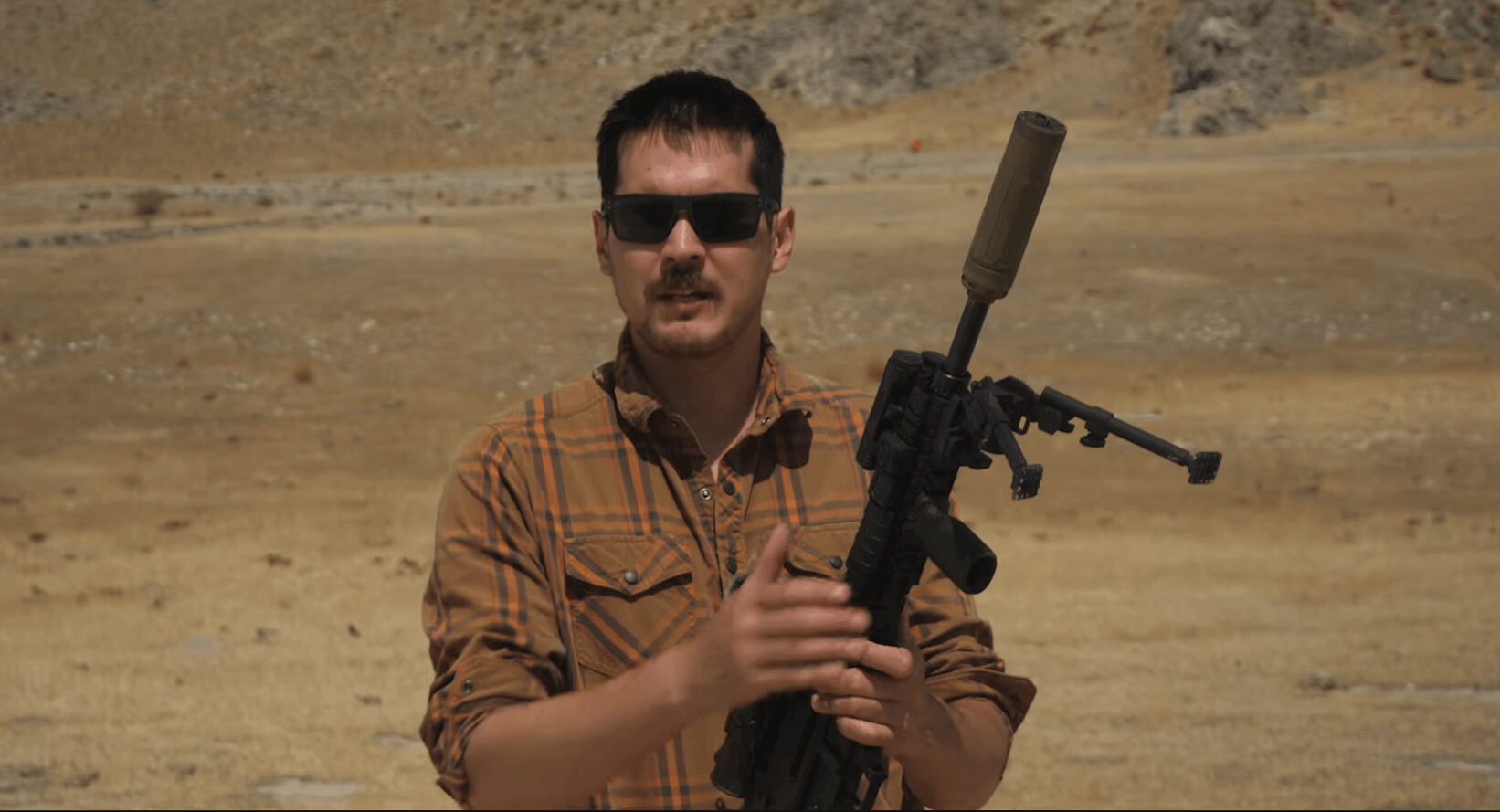
In a clip after the sign-off, the host acknowledges that the rifle shown throughout is technically not an HK416 but an MR556, Heckler & Koch's semi-automatic civilian counterpart. The MR556 shares the 416's short-stroke piston design and lacks select-fire capability. Earlier, the video sets it beside a rifle the host describes as a clone of the M4 configuration special operations units carried, for side-by-side comparison.
The host sums up the HK416 as the product of a particular period in military history, a rifle born from users who treated their weapons harshly, whose record, per the video, includes Delta Force, the SEAL unit, several national militaries and the U.S. Marine Corps.
For context
- The HK416 is Heckler & Koch's 5.56mm rifle built on the AR-15 and M4 layout, with a short-stroke gas piston derived from the company's G36 in place of the direct gas system.
- Delta Force replaced its M4s with HK416s in 2005 after testing found fewer malfunctions and longer parts life, according to published histories of the rifle.
- The U.S. Marine Corps' M27 Infantry Automatic Rifle, fielded from 2011, is a variant of the HK416.
- Operation Neptune Spear was carried out on the night of May 1 to 2, 2011, and ended the nearly ten-year search for bin Laden.